The short answer
A neocloud is a cloud provider built around renting GPUs for AI work, rather than a general-purpose cloud that added GPUs to a catalogue of hundreds of services. It sells compute by the GPU-hour or by the cluster, on hardware it runs in leased or self-built data centers, to AI labs, model developers and enterprises. The word is recent and loose, but the business is not small. CoreWeave, the largest listed neocloud, reported revenue of $5.1 billion for 2025 and $60.7 billion of remaining performance obligations at the end of the year.
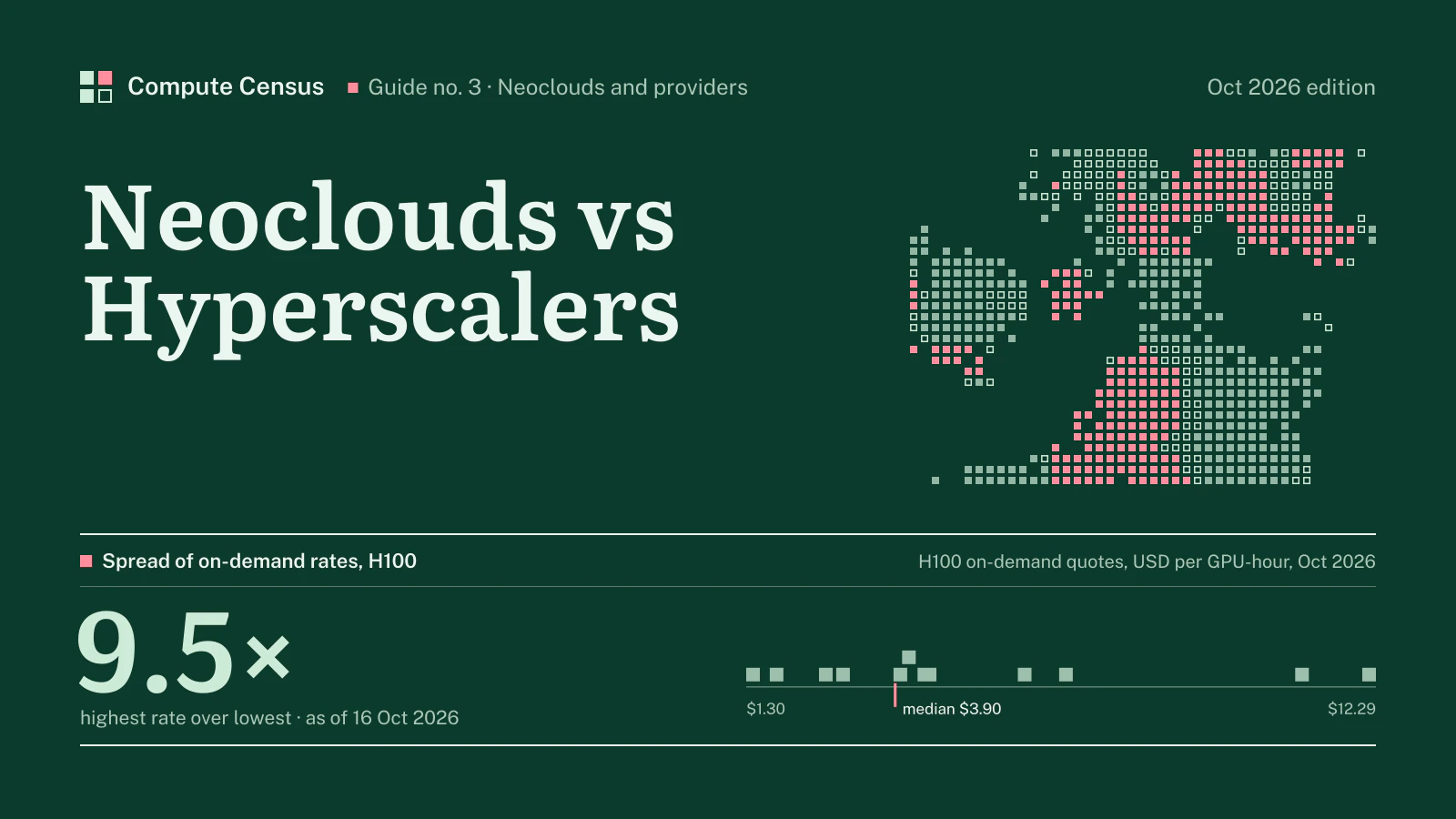
On price, the difference from the hyperscalers is large. In the Compute Census index of 6 Nov 2026, the cheapest H100 offer is $1.30 per GPU-hour and the most expensive list price, a hyperscaler’s, is $12.29: a spread of 9.5×. Most neoclouds sit in the lower half of that range on published rates.
The rest of this guide sets out what makes a neocloud different, who the companies are according to their own filings, what they charge against AWS, Microsoft Azure and Google Cloud, how their contracts work, where their capacity is being built, and which risks a buyer should weigh before signing.
What makes a cloud a neocloud
GPU-first, not GPU-also
The hyperscalers sell everything: storage, databases, networking, identity, analytics, machine-learning platforms and GPUs among them. Their GPU instances are one product line inside an enormous catalogue, sold to customers who are already on the platform. A neocloud reverses the order. GPUs are the product, and storage, networking and orchestration exist to keep them busy.
That shapes everything else. Neocloud data centers are designed around dense GPU racks, liquid cooling and the fast fabrics that training jobs need. Their customer lists are short and their contracts large. Their sales teams talk about clusters, terms and delivery dates more than about self-service consoles, although most also run one.
Three kinds of company behind the label
The companies called neoclouds came from three directions.
- GPU specialists. CoreWeave and Lambda built their businesses around GPU computing and grew into clouds as AI demand arrived. Nebius describes itself as a technology company building full-stack infrastructure for the AI industry, headquartered in Amsterdam and listed on Nasdaq.
- Energy and mining companies. IREN, Core Scientific, TeraWulf, Hut 8 and others built large sites with grid connections to mine bitcoin. Grid connections are now among the scarcest inputs in AI, and several of these companies host GPUs for others or run their own GPU clouds on the same land.
- Developers turned operators. Crusoe builds campuses and runs a cloud on them; Nscale and Fluidstack combine a GPU cloud with data center development in Europe and the United States.
In our campus census these origins are visible in the operator column. CoreWeave appears as a tenant on Galaxy’s Helios campus in Texas and at Core Scientific sites; Nebius as the builder of its own AI factories in Missouri, Pennsylvania, New Jersey and Finland; Crusoe at Abilene and Childress; IREN at Sweetwater and Childress; TeraWulf and Fluidstack at Abernathy. The common thread is control of power, not ownership of a software platform.
Why the hyperscalers did not fill the gap alone
The hyperscalers have the money and the buildings, but GPU supply did not keep up with demand. AWS said as much in June 2025, when it cut GPU instance prices: demand for GPU capacity had outpaced industry-wide supply, making GPUs a scarce resource. Neoclouds filled part of that gap, and the hyperscalers became some of their largest customers. Microsoft’s contracts with both CoreWeave and Nebius are the clearest evidence.
The companies in public numbers
CoreWeave
CoreWeave’s 2025 annual report gives the clearest picture of a neocloud at scale. Revenue was $5.1 billion in 2025, up from $1.9 billion in 2024 and $229 million in 2023. At the end of 2025 it operated 43 data centers with more than 850 MW of active power and had total contracted power of approximately 3.1 GW to deploy in future periods. Its remaining performance obligations, the revenue it has contracted but not yet recognised, stood at $60.7 billion, against $15.1 billion a year earlier.
The same report shows how concentrated that business is. CoreWeave recognised approximately 67% of its 2025 revenue from its top customer, Microsoft. Committed contracts, which it describes as take-or-pay, accounted for more than 98% of revenue in 2025. Beyond Microsoft, the filing lists commitments from OpenAI of up to approximately $6.5 billion through May 2031 and from Meta of up to approximately $14.2 billion initially. OpenAI’s first agreement, announced in March 2025, was valued at up to $11.9 billion and came with a $350 million investment in CoreWeave stock.
CoreWeave also publishes a price list, which most of its large customers will never pay. Its on-demand HGX H100 node costs $49.24 per hour for eight GPUs, and the same node on spot costs $19.71, according to its pricing page in October 2026. The gap between those two numbers says more about neocloud economics than either alone: list prices anchor negotiations, and actual capacity moves on contracts.
Nebius
Nebius is the second listed neocloud of comparable ambition. In September 2025 it announced a multi-year agreement to deliver dedicated capacity to Microsoft from a new data center in Vineland, New Jersey. Its filing put the total contract value at about $17.4 billion through 2031, over a five-year term, rising to about $19.4 billion if Microsoft takes additional services. Nebius said it expected to finance the capital spending for the contract through cash flow from the deal and debt secured against it.
Growth since then has been fast and capital-hungry. For the second quarter of 2026, Nebius reported revenue of $582.3 million, up 454% from $105.1 million a year earlier, and purchases of property, equipment and intangible assets of $5,657.4 million in the same quarter. Silicon UK reported in September 2026 that Nebius had signed four customer contracts worth more than $1 billion each during the quarter.
Nebius is also the clearest case of a neocloud raising prices. From 1 October 2026 it charged roughly 17% more for H100 instances and 21% more for B300 instances, its second increase in three months, according to the same report. Its price page in October listed the HGX H100 at $4.50 per GPU-hour and the HGX H200 at $5.40.
Lambda and the rest
Lambda publishes a compact price list with one detail most providers hide: the price per GPU falls as the instance grows. In October 2026 a B200 cost $6.69 per GPU-hour in an eight-GPU instance and $6.99 alone; the H100 SXM ran from $3.99 to $4.29 the same way. Lambda also sells clusters and dedicated capacity on quoted terms.
The largest public examples are CoreWeave and Nebius, both listed on Nasdaq. Around them sits a wider group: Lambda, Crusoe, Nscale and Fluidstack among the GPU clouds, and former bitcoin miners such as IREN, Core Scientific, TeraWulf and Hut 8 that have turned their power and sites into AI capacity. Below them the field is wide: GPU clouds without campuses of their own, mid-sized providers such as DigitalOcean and Civo that added GPU instances to developer clouds, and marketplaces such as Vast.ai that aggregate other people’s hardware. Our index records prices from many of them; Table 1 lists the H100 offers.
Table 1H100 offers by provider, USD per GPU-hour
| Provider | Offer | USD / GPU-hr | As of |
|---|---|---|---|
| Lium.io | Marketplace | $1.30 | 2026-09-21 |
| Beam | On-demand | $1.83 | 2026-10-20 |
| CoreWeave | Spot | $2.46 | 2026-10-20 |
| Runpod | On-demand | $2.69 | 2026-10-16 |
| Civo | Reserved, 12 mo | $2.69 | 2026-10-20 |
| Civo | On-demand | $2.99 | 2026-10-20 |
| DigitalOcean | Reserved, 12 mo | $3.26 | 2026-09-28 |
| Runpod | On-demand | $3.99 | 2026-10-16 |
| Lambda | On-demand | $3.99–$4.29 | 2026-10-16 |
| DigitalOcean | On-demand | $4.41 | 2026-10-20 |
| Nebius | On-demand | $4.50 | 2026-10-16 |
| CoreWeave | On-demand | $6.16 | 2026-10-20 |
| AWS | On-demand | ~$6.88 | 2026-10-16 |
| Google Cloud | On-demand | ~$11.00 | 2026-10-16 |
| Microsoft Azure | On-demand | $12.29 | 2026-10-16 |
Price points recorded by the Compute Census index for the H100; third-party index rows are context, not providers. Full table: H100 rental price.
What neoclouds charge against the hyperscalers
The published gap
Are neoclouds cheaper than AWS, Azure and Google Cloud? On published on-demand prices, almost always. The hyperscalers’ list prices for training-class GPUs sit at the top of our index. The comparison changes once discounts, data transfer and integration are counted, so the list price is only the first step.
On published on-demand prices, the hyperscalers sit at the top of the market for training-class GPUs. The H100 median in our index is $3.90 per GPU-hour against a ceiling of $12.29, and the ceiling belongs to a hyperscaler’s eight-GPU virtual machine. The same pattern holds for the H200, where the median is $4.80 and the ceiling $13.78, and for the B200, with a median of $6.90 and a ceiling of $16.11.
Table 2Training-class GPUs in the index: median, range and providers, USD per GPU-hour
| Model | Median | Floor | Ceiling | Providers |
|---|---|---|---|---|
| H100 | $3.90 | $1.30 | $12.29 | 11 |
| H200 | $4.80 | $2.09 | $13.78 | 9 |
| B200 | $6.90 | $3.69 | $16.11 | 12 |
| GB200 | $13.25 | $8.00 | $27.04 | 5 |
USD per GPU-hour, on-demand unless stated. Compute Census GPU price index of 6 Nov 2026.
Neoclouds fill the middle of that range, and marketplaces the bottom. A buyer comparing a neocloud’s H100 rate with a hyperscaler’s list price will usually find the neocloud several times cheaper per GPU-hour. The table of H200 offers shows the same structure for the newer part.
Table 3H200 offers by provider, USD per GPU-hour
| Provider | Offer | USD / GPU-hr | As of |
|---|---|---|---|
| Jarvislabs | Spot | $1.99 | 2026-09-21 |
| Beam | Serverless | $2.09 | 2026-09-21 |
| Beam | On-demand | $2.09 | 2026-10-20 |
| GMI Cloud | On-demand | $2.60 | 2026-09-21 |
| Civo | Reserved, 12 mo | $3.19 | 2026-10-20 |
| DigitalOcean | Reserved, 12 mo | $3.40 | 2026-09-21 |
| Civo | On-demand | $3.49 | 2026-10-20 |
| Jarvislabs | On-demand | $3.99 | 2026-09-21 |
| GetDeploying median | Third-party index | $4.40 | 2026-09-21 |
| DigitalOcean | On-demand | $4.47 | 2026-10-20 |
| Runpod | On-demand | $5.29 | 2026-10-20 |
| Nebius | On-demand | $5.40 | 2026-10-20 |
| CoreWeave | On-demand | $6.31 | 2026-10-20 |
| Microsoft Azure | On-demand | $13.78 | 2026-09-21 |
Price points recorded by the Compute Census index for the H200; third-party index rows are context, not providers. Full table: H200 rental price.
Why the gap exists
Three reasons explain most of it. First, product scope: a hyperscaler’s GPU price carries a share of everything around it, from identity and compliance to managed services and support. Second, customer mix: hyperscalers sell to enterprises that value integration and pay list or discounted list prices, while neoclouds compete for AI teams that compare per-GPU rates. Third, the list price is not the transaction price at the hyperscalers either. Large customers negotiate reserved rates, savings plans and enterprise agreements that are not published.
The hyperscalers have moved. AWS cut its On-Demand prices for P5 (H100) instances by 44% and for P5en (H200) by 25% in June 2025, and it sells short reservations called Capacity Blocks at published rates. In October 2026 a Capacity Block of eight H100s cost $5.970 per GPU-hour in most US regions. That is closer to neocloud pricing than the on-demand list, but still above the H100 median.
Where the hyperscalers still win
Price per GPU-hour is not the only cost. Moving terabytes of training data out of a hyperscaler to train elsewhere costs money and time. Running a second platform needs engineers, security reviews and new contracts. For a company whose data, applications and compliance processes already live on AWS, Azure or Google Cloud, those costs can outweigh a lower GPU rate for small or short jobs. For a large, long training run whose inputs can be moved once, they rarely do.
What is inside a neocloud’s price
The anatomy of a GPU-hour
A neocloud’s hourly rate has to cover the same costs an owner would carry: the GPU server, written off over a few years; the power it draws and the facility overhead on top; the rack space, cooling and network in the data center; the storage and the operations team; and a margin. The difference is that the neocloud spreads those costs across many customers and many hours, and that it buys hardware, power and space in volume. The rate a customer sees is that cost, divided by the hours the provider expects to sell, plus whatever the market will bear.
That last part explains why rates for the same GPU vary so much across providers. A neocloud with long contracts covering most of its fleet can sell its spare hours cheaply; one that has just built a new hall with no anchor tenant prices to fill it; one with more demand than capacity raises prices, as Nebius did. Published rates are snapshots of each provider’s position, not a cost-plus formula.
Spot, size and term
Three published levers show how far below the headline rate a buyer can go. The first is spot pricing for capacity that can be reclaimed. CoreWeave’s spot rate for an eight-GPU H100 node, $19.71 an hour, is about 40% of its on-demand rate for the same node. The second is size: Lambda charges less per GPU for an eight-GPU instance than for one GPU, because whole servers are easier to schedule. The third is term. Civo’s published ladder for the H100 SXM falls from $2.99 an hour on demand to $2.79 on a six-month commitment, $2.69 on twelve months, $2.59 on twenty-four and $2.49 on thirty-six.
Each lever trades something for the discount: spot trades reliability, size trades flexibility, term trades the option to leave. A buyer who knows which of those it can give up knows where to negotiate.
Storage and data transfer
GPU rates are only part of a bill. Training data has to be stored near the GPUs, and results and checkpoints have to be moved out. Neoclouds publish these prices too, and they are worth reading. Nebius’s price page in October 2026 listed its shared filesystem at $0.08 per GiB per month, standard object storage at $0.0147 per GiB per month and egress from object storage at $0.015 per GiB. Civo marks data transfer on its GPU instances as free. For a workload that moves hundreds of terabytes, those lines can matter as much as a few cents on the GPU-hour, and they are one of the clearest ways neoclouds compete with the hyperscalers’ bundled pricing.
A worked comparison
Sixty-four H100s for a quarter
Consider a team that needs 64 H100 GPUs, eight servers, for three months of continuous training. At the median on-demand rate in our index, one H100 for a full month costs $2,847, so the job needs 192 of those GPU-months. On a published twelve-month reserved rate, a single GPU-month costs $2,380, although a three-month job would not normally qualify for a one-year term.
The hyperscaler route gives a different set of numbers. An AWS Capacity Block of eight H100s cost $47.757 per instance-hour in October 2026, or $5.970 per GPU-hour, which works out at about $4,358 per GPU-month over 730 hours. On-demand list prices at the large clouds are higher still; the H100 ceiling in our index, $12.29, belongs to an on-demand hyperscaler instance.
What the arithmetic leaves out
The comparison above prices GPUs only. A real quote adds storage for the training data and checkpoints, data transfer in and out, support, and sometimes a minimum term or volume. It also has to answer the question the hourly rate cannot: whether 64 GPUs in one building on one fabric are available for the dates the team needs. A neocloud with a slightly higher rate and confirmed capacity next month is usually worth more than a cheaper offer that cannot deliver.
AMD at the neoclouds
Neoclouds are also where most of AMD’s data center GPUs can be rented. The MI300X, with 192 GB of memory, has a median of $2.99 per GPU-hour from 7 providers in our index, most of them specialist clouds rather than hyperscalers. The newer MI355X, with 288 GB, is offered by a mix of GPU clouds and large clouds, as the table shows. For memory-bound models, AMD capacity at a neocloud is often the cheapest way to get a large amount of GPU memory in one place.
Table 4AMD MI355X offers by provider, USD per GPU-hour
| Provider | Offer | USD / GPU-hr | As of |
|---|---|---|---|
| Daytona | Preemptible | $3.44 | 2026-09-18 |
| CoreWeave | Reserved, 12 mo | $4.25 | 2026-09-18 |
| DigitalOcean | Spot | $4.50 | 2026-09-18 |
| Daytona | On-demand | $5.99 | 2026-09-18 |
| OVHcloud | On-demand | ~$7.10 | 2026-09-18 |
| Vultr | On-demand | ~$7.10 | 2026-09-18 |
| CoreWeave | On-demand | ~$7.20 | 2026-09-18 |
| Oracle Cloud | On-demand | $8.60 | 2026-09-18 |
Price points recorded by the Compute Census index for the MI355X; third-party index rows are context, not providers. Full table: MI355X rental price.
The trade-off is software. Most AI code is written and tuned first for NVIDIA’s CUDA, and teams moving to AMD need time to validate their stack. Neoclouds that offer AMD usually help with that work, because it is how they win customers from NVIDIA-only competitors.
Regional and sovereign neoclouds
Not every neocloud is American. Our census includes GPU-cloud and AI-campus operators building in Europe, Asia and Australia, often with a pitch about keeping data and compute inside a country. Nscale has sites in the United Kingdom and Norway, including the Narvik campus once announced as Stargate Norway. Firmus plans AI factories in Indonesia and South Australia. In Indonesia, a joint venture of local telecom operators is building what it calls sovereign AI campuses, and CoreWeave has announced its own first Asia-Pacific campus near Jakarta.
For buyers bound by data-residency rules, these providers widen the choice beyond the hyperscalers’ regional data centers. Their prices are less often published, and their capacity is smaller, so they are typically engaged on quoted terms.
Prices have stopped falling
For much of the period our history covers, the story of GPU rental was falling prices as supply caught up: the H100 median peaked at $8.00 in 1 Jun 2023 and fell for a long time afterwards. In 2026 the direction changed at the neoclouds. Nebius’s two increases are documented; CoreWeave said in September 2026 that it was signing new contracts at higher prices, as Silicon UK reported. Our own history shows the same turn in the H100 market.
Figure 1H100: median on-demand rental price and published range, USD per GPU-hour, 2023-06-01 to 2026-11-06
The H100 median stands +100% against a year earlier, on 1 Oct 2025. That is not the pattern of a part sliding towards obsolescence. Demand for inference, the arrival of new models and the slow delivery of power for new campuses have kept even the previous generation in demand. For buyers, it means that a quote is worth more than a list price, and that the moment to secure capacity for the next year is before it is needed.
Contracts, capacity blocks and terms
Take-or-pay is the core of the business
The economics of a neocloud rest on long contracts. CoreWeave’s report says that more than 98% of its 2025 revenue came from committed contracts that are take-or-pay: the customer pays for the reserved capacity whether it uses it or not. That is what lets a neocloud borrow against its contracts to buy GPUs and build data centers, as Nebius said it would for its Microsoft deal. On-demand rentals are a small part of revenue, offered from spare capacity.
For a buyer, this has two consequences. Large blocks of the newest GPUs are usually committed before they are delivered, so availability on demand can be thin even when a price is published. And the terms that matter — length, volume, delivery date, service levels — are negotiated, not listed.
Published terms where they exist
A few providers do publish term prices, and they give a sense of the discount. Civo lists every GPU size with on-demand, six-, twelve-, twenty-four- and thirty-six-month rates; its H100 SXM costs $2.99 per hour on demand and $2.69 on a twelve-month commitment. Nebius offers commitment discounts for multi-month cluster reservations without publishing the figures. AWS’s Capacity Blocks reserve instances for a fixed window at a published price. Our index records twelve-month rates where they are public; the H100’s is $3.26, or −16% against the on-demand median.
Clusters, not instances
The largest neocloud contracts are for clusters: thousands of GPUs in one building on one fabric, delivered in phases. The SoftBank, OpenAI and Oracle announcement of September 2025 listed ongoing Stargate projects with CoreWeave alongside the flagship campus in Abilene. Contracts of that kind specify the building, the network and the delivery schedule, and they are priced per GPU-hour over years. A smaller buyer will not see those terms, but should ask for the same elements in any quote for more than a few nodes.
Where neocloud capacity is being built
Leased halls and owned campuses
Neoclouds put their GPUs in two kinds of building: halls leased from data center developers and campuses they build or control themselves. CoreWeave’s 43 data centers at the end of 2025 included both, and its contracted 3.1 GW is mostly capacity that others are building for it. Nebius takes the other route more often, building its own AI factories. Our census shows both patterns in the records it holds.
The census counts 665 AI campuses with a pipeline of 88.7 GW under construction and announced. A large share of the gigawatt-class projects are being built by companies that sell capacity to GPU clouds or are GPU clouds themselves.
Table 5AI campuses in the census by published capacity class
| Capacity class | Campuses | With published MW | Published MW |
|---|---|---|---|
| 1 GW or more | 27 | 27 | 41,730 |
| 500–999 MW | 18 | 18 | 11,386 |
| 100–499 MW | 156 | 156 | 33,370 |
| Under 100 MW | 295 | 295 | 11,380 |
| Not published | 169 | 0 | 0 |
Compute Census AI campus census, records to 15 Nov 2026. MW summed only where a source publishes a figure. Full list: AI data center census.
Power is the constraint
The common factor across neocloud campuses is power secured ahead of time. Several former bitcoin miners became AI hosts on the strength of their grid connections; developers sign utility contracts years in advance; some campuses build their own generation. Delays in power are the main risk to a neocloud’s delivery schedule. Our register of capacity statements includes a reminder from the Oracle side of the market: in September 2026 Oracle told a developer it might defer rent on a New Mexico campus if a delayed gas pipeline held up power. When a neocloud quotes a delivery date for a large cluster, the question to ask is where the power for that cluster is coming from and whether it is already contracted.
Table 6AI campuses in the census by status
| Status | Campuses | With published MW | Published MW |
|---|---|---|---|
| Under construction | 259 | 227 | 51,090 |
| Announced | 131 | 111 | 37,645 |
| Operational | 275 | 158 | 9,132 |
Compute Census AI campus census, records to 15 Nov 2026. MW summed only where a source publishes a figure. Full list: AI data center census.
The risks behind the growth
Three stand out in the filings: concentration, financing and delivery. CoreWeave reported that its top customer, Microsoft, accounted for about 67% of its 2025 revenue. Nebius said it expected to finance the capital spending for its Microsoft contract partly with debt secured against the contract.
Concentration
Neocloud revenue is concentrated in a few customers. CoreWeave’s 67% from Microsoft in 2025 is the extreme, but a business built on a handful of multi-billion-dollar contracts is exposed to any one of them changing course. For a small customer, concentration cuts both ways: it funds the capacity you rent, but it also means your workload is a small priority beside the anchor tenant’s. It also links the neocloud’s fortunes to its largest customers’ plans. If one of them builds more of its own capacity, or shifts work to another supplier, the neocloud has a large block of GPUs to resell at short notice, which can be good news for smaller buyers in the short run and bad news for the provider’s finances.
Financing
Building GPU capacity at this pace needs capital far beyond current revenue. Nebius spent more than $5.6 billion on property, equipment and intangibles in the second quarter of 2026 alone, against quarterly revenue of $582.3 million. Neoclouds fund the gap with equity, contract-backed debt and partnerships. The model works while contracts are honoured and GPUs keep their value for the length of the debt. A sharp fall in GPU rental prices, or the loss of a large customer, would test it. For customers, the practical defence is diversification: spreading important workloads across more than one provider, keeping data portable, and avoiding prepayments larger than the provider’s delivery record justifies.
Delivery and price
The last risk is practical. A neocloud that is still building its capacity can miss a delivery date when power, equipment or construction slip. And a provider that raised prices twice in a year can do so again. Neither is a reason to avoid neoclouds; both are reasons to put delivery commitments, remedies for delay and price terms in writing.
What to put in writing
Delivery
For any capacity that does not exist yet, the contract should name the building, the number and type of GPUs, the network and the date each phase becomes available, and it should say what happens if a date slips: a credit, a right to cancel, or substitute capacity elsewhere. A neocloud’s own delivery depends on power, equipment and construction that it does not fully control, and the risk should be shared explicitly rather than discovered later.
Performance and failure
GPU servers fail more often than ordinary servers, because they run hot and at full load for long periods. A training contract should say how quickly a failed node is replaced, whether spare nodes are held in reserve, and how service credits are calculated. It should also state the network the cluster runs on and whether that network is shared with other customers, because a congested fabric slows a training job as surely as a missing GPU.
Price and term
The price clause should fix the rate for the term and say when, and by how much, the provider may change it on renewal. Nebius’s increases in 2026 applied to its published on-demand rates; customers on committed contracts are protected by their terms, which is precisely the point of having them. The exit clause matters as much: a buyer locked into three years of a GPU generation that the market has moved past is paying for the provider’s financing, not for its own compute.
How to choose a neocloud
Match the provider to the job
Start with the workload. A training run on hundreds of GPUs needs a provider that can deliver whole eight-GPU servers on a non-blocking fabric in one building. Inference at scale needs availability in the right regions and a way to grow capacity smoothly. Development and experiments need flexibility and low prices more than guarantees. Different neoclouds are strong in different places, and the cheapest list price is rarely the deciding factor.
Questions to ask
- Is the capacity dedicated, reserved, on-demand or spot, and what happens when demand spikes?
- Which GPUs, in what server configuration, on which fabric, at what speed per GPU?
- Where is the data center, who owns it, and is its power contracted today?
- What are the term, the minimum volume and the exit terms, and how are price changes handled?
- What are the service levels for node failure and replacement, and what credits apply?
- What does it cost to bring data in and take it out?
Compare like with like
Convert every offer to a price per GPU-hour for the same GPU in the same configuration, then add storage, data transfer and support. Compare neocloud quotes with each other and with a hyperscaler’s negotiated rate, not its list price. And for steady multi-year use, compare all of them with the cost of owning servers, which our H100 price guide works through for one part.
We handle both routes. GPU capacity is available for rent through neocloud and other partners, and hardware for purchase through different partners, on terms agreed individually for each request. Tell us the GPUs, quantity, term and location in the form below, and we come back with what is available and on what terms.