The short answer
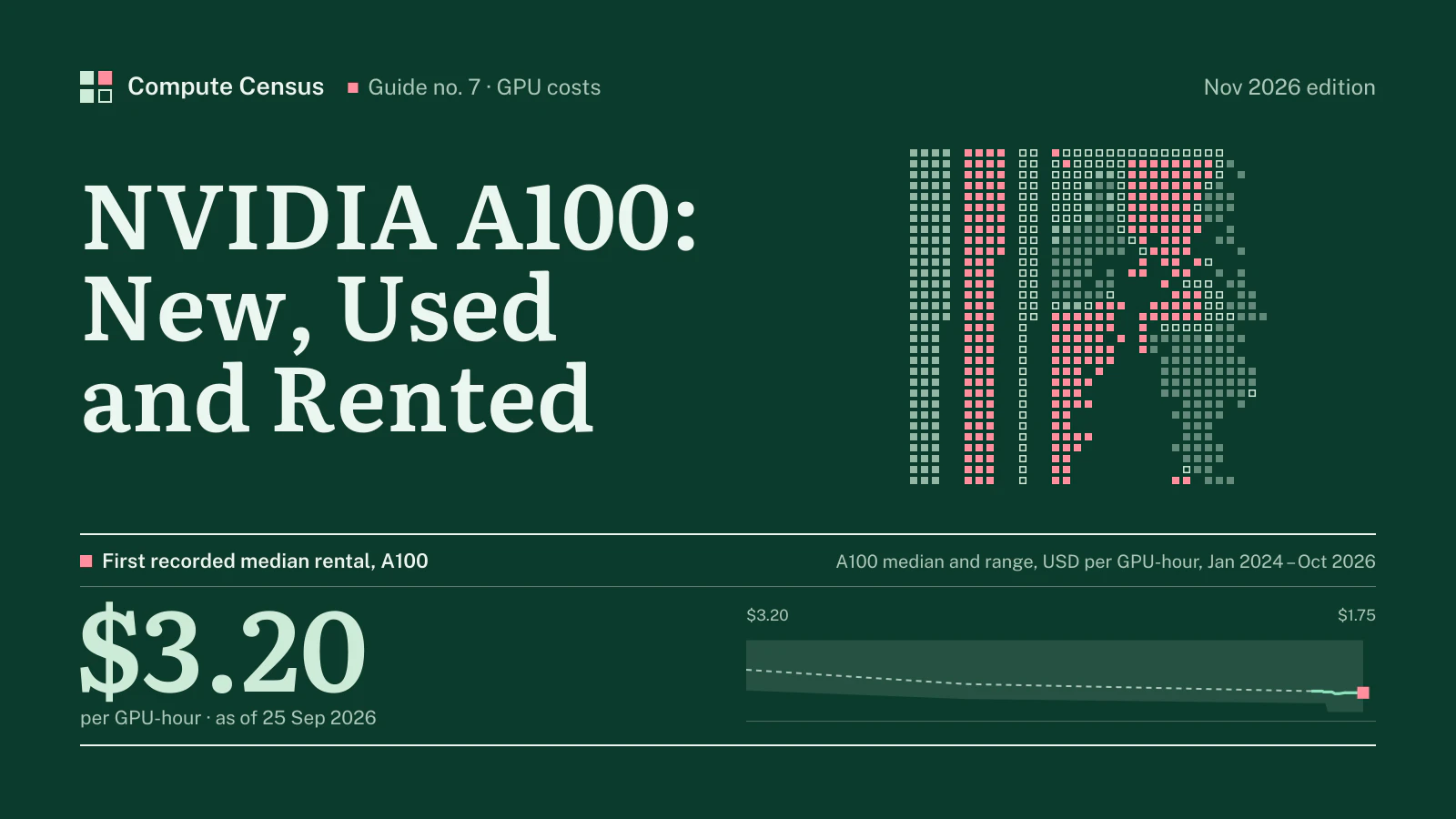
The NVIDIA A100 is the oldest data center GPU in our index and the one whose price has fallen furthest. In the Compute Census index of 16 Oct 2026, an A100 80GB rents for $1.75 per GPU-hour at the median and as little as $0.53 on a marketplace. When our history begins, on 1 Jan 2024, the median was $3.20.
Buying one is a used-market purchase. NVIDIA no longer sells the A100 as its flagship, and most cards now change hands second-hand or refurbished. Compute Exchange’s indicative range for used A100 80GB units in the third quarter of 2026 is $7,000 to $9,500, according to IntuitionLabs, with final prices depending on quantity, region, condition and warranty. Refurbished 40GB units through specialised channels run closer to $7,800. At launch in May 2020, a DGX A100 with eight of them started at $199,000.
This guide starts where the A100 market is today, with used cards and cheap rentals, and works back: what the A100 cost new and what it delivered, how its rental price has declined, who rents it and at what rates, where buying a used card beats renting one, how it compares with its successors, and how export controls shaped its history.
The used market in 2026
Prices without a list
The A100 trades on a market with no price list and few public records of completed sales. IntuitionLabs, in a September 2026 review of used AI GPU prices, is explicit about that: its figures are channel-specific asking prices and provider-published indicative ranges, not independently observed transactions, and they vary by condition and form factor. With that caveat, the picture is consistent enough to use.
For the 40GB card, IntuitionLabs gives a new-unit reference of around $10,000 to $12,000, refurbished units through specialised channels closer to $7,800, and individual asking prices far lower: a Reddit commenter reported used cards going for $2,000 to $4,000, and single listings it observed included an SXM4 module at $2,500 and a PCIe card at $4,500. For the 80GB version, which is the model in our index, it cites Compute Exchange’s indicative range of $7,000 to $9,500.
Why the spread is so wide
A used A100 can be many different things. The SXM4 module only works on an HGX baseboard or in a DGX; outside one, it is nearly useless, which is why loose SXM4 modules sell cheaply. The PCIe card fits an ordinary server and is easier to resell. A card from a decommissioned cluster may have run at full load for three years; one from a cancelled project may be nearly new. Warranty may or may not survive the resale: NVIDIA directs owners to check the warranty for each specific product, and resellers offer their own terms.
Buyers should therefore compare like with like: form factor, memory, condition, warranty and quantity. A lot of eight matched cards with a reseller warranty is worth more per card than a single unit from an individual seller, and an SXM4 module is worth little to a buyer without the board it plugs into.
Servers on the used market
Complete eight-GPU A100 servers also reach the secondary market as cloud providers and enterprises retire them. They are the practical unit for training and for multi-GPU inference, because the eight GPUs come with the NVLink fabric and the network adapters that a cluster needs. Prices depend on the server maker, the CPUs, memory and networking, and the condition of all of them; we found no consistent public series of completed sales to cite. A buyer should ask for the server’s service history, the age of its power supplies and fans, and a burn-in test before payment.
40GB or 80GB
The two memory sizes are priced closer together on the used market than their specifications suggest, and further apart on the rental market. IntuitionLabs puts refurbished 40GB units through specialised channels at around $7,800 and Compute Exchange’s used 80GB range at $7,000 to $9,500: the channels differ, so the overlap says more about where a card is sold than about its value. In rentals the gap is clearer. Lambda’s price list in October 2026 offered A100 40GB instances at $1.99 per GPU-hour and its eight-GPU A100 SXM 80GB instance at $2.79.
For most AI work in 2026, the 80GB version is the one to choose. Models have grown, and the extra memory decides whether a model fits on one GPU or must be split across two. The 40GB card remains useful for smaller models, for development and for workloads partitioned into small instances, and its lower price makes it a reasonable buy for those uses.
Testing a used card before you pay
A used GPU should be tested, not trusted. Before accepting a card or a server, run the vendor’s management tools to confirm the model, memory size and firmware; check the error counters for memory errors that have been corrected or retired; run a sustained load for several hours while watching temperatures, clock speeds and power draw; and run a memory test across the full capacity. A card that throttles under load, reports retired memory pages or fails a stress test should go back.
For servers, test every GPU and the links between them, not a sample. Check that all eight GPUs in an HGX server see each other over NVLink at full bandwidth, that the network adapters negotiate their full speed, and that the power supplies and fans are healthy. Ask the seller to agree in advance to a return window long enough to run those tests.
Selling A100s
Owners retiring A100s face the other side of the same market. The useful life the largest buyers assign to servers in their accounts has lengthened: Meta raised its estimate for most servers and network assets to 5.5 years, and Microsoft and Alphabet use five or six years, according to IntuitionLabs’ review of their filings, while Amazon shortened the estimate for part of its fleet. Those are accounting estimates rather than physical lifespans, but they show that hardware of the A100’s generation is expected to stay in service for years. For sellers, that means demand for working A100s persists, especially for complete, tested servers with a documented history; loose SXM4 modules without boards fetch the least.
What the A100 cost new, and what it bought
The DGX A100 at launch
When NVIDIA unveiled the DGX A100 on 14 May 2020, it said systems started at $199,000. The system carried eight A100 GPUs with 320GB of GPU memory in total and delivered 5 petaflops of AI performance. It had HDR 200 Gb/s interconnects for clustering and could be partitioned into as many as 56 GPU instances using the A100’s multi-instance feature. The first order, NVIDIA said, went to the US Department of Energy’s Argonne National Laboratory.
NVIDIA later offered 80GB versions of the A100 with more memory and higher bandwidth, and that is the version most rental offers mean today.
Variants: 40GB, 80GB, PCIe and SXM
The A100 comes in four combinations of memory and form factor, and their prices differ for good reasons. NVIDIA’s specifications for the 80GB versions show the differences:
- A100 80GB PCIe: 1,935 GB/s of memory bandwidth, a maximum power of 300 W, dual-slot air-cooled or single-slot liquid-cooled, with an NVLink bridge for two GPUs at 600 GB/s.
- A100 80GB SXM: 2,039 GB/s of memory bandwidth, a maximum power of 400 W, NVLink at 600 GB/s across an HGX baseboard of up to eight GPUs.
- 40GB versions of both, with half the memory and lower bandwidth, which are cheaper on every market.
Every version supports up to seven Multi-Instance GPU partitions of 10GB each on the 80GB models. NVIDIA says the A100 delivered up to 20 times the performance of the previous generation and that the 80GB version debuted memory bandwidth of over 2 TB/s.
Power
The DGX A100 draws up to 6.5 kW from six 3,000 W power supplies in a 3+3 redundant configuration, according to NVIDIA’s user guide, in a 6U chassis weighing up to 123.16 kg. Divided by eight, that is about 813 W per GPU at the server, once CPUs, memory, network adapters and fans are included. That is far less than a Hopper or Blackwell system draws per GPU, and it is one reason A100 servers fit in data centers that cannot host newer AI racks.
The rental price: a long decline
Six years of history
The A100’s rental price tells the story of a part moving from scarcity to surplus. Our history, seeded from published indices before the tracker began and recorded directly since, shows the median falling from $3.20 on 1 Jan 2024 to $1.75 today. Against a year earlier, the median has moved not published; the most recent change in the series was +3.6%, on 25 Sep 2026.
Figure 1A100: median on-demand rental price and published range, USD per GPU-hour, 2024-01-01 to 2026-10-26
Three forces drove the decline. Supply grew as cloud providers installed tens of thousands of A100s in 2021 and 2022. Hopper arrived in 2023 and drew the most demanding work away. And a growing number of A100s reached marketplaces, where idle cards compete on price. The hyperscalers followed: AWS cut On-Demand prices for its A100-based P4d and P4de instances by 33% in June 2025, as part of the reductions of up to 45% it announced across its GPU instances.
The market today
Our index records 10 A100 price points from 8 providers. The cheapest on-demand offer is $0.53 and the most expensive list price $5.07, a spread of 9.6×. A published 12-month reserved rate stands at $1.59, −9% against the on-demand median.
Table 1A100 prices by provider, USD per GPU-hour
| Provider | Offer | USD / GPU-hr | As of |
|---|---|---|---|
| Vast.ai | Marketplace | ~$0.53 | 2026-09-25 |
| Thunder Compute | On-demand | $1.09 | 2026-09-25 |
| Beam | On-demand | $1.36 | 2026-10-20 |
| Civo | Reserved, 36 mo | $1.39 | 2026-09-25 |
| Civo | Reserved, 12 mo | $1.59 | 2026-09-25 |
| GetDeploying median | Third-party index | ~$1.75 | 2026-09-25 |
| Civo | On-demand | $1.79 | 2026-09-25 |
| Runpod | On-demand | $1.79 | 2026-10-20 |
| CoreWeave | On-demand | $2.21 | 2026-09-25 |
| Lambda | On-demand | $2.79 | 2026-10-20 |
| Google Cloud | On-demand | ~$5.07 | 2026-09-25 |
Price points recorded by the Compute Census index for the A100; third-party index rows are context, not providers. Full table: A100 rental price.
The table shows the same three bands as for newer parts, but lower. Marketplace hosts set the floor; Vast.ai, whose prices are set by supply and demand among hosts, is recorded with a range that depends on host reliability. GPU clouds sit in the middle: Runpod listed its A100 SXM and A100 PCIe 80GB pods at $1.79 an hour in October 2026, Civo its single-GPU A100 80GB at $1.79 on demand, and Lambda its eight-GPU A100 SXM 80GB instance at $2.79 per GPU. The large clouds sit at the top.
Azure ND A100 v4
Azure sells the A100 in two eight-GPU virtual machine sizes, priced by region; Spare Cores tracks those prices. Spare Cores records the ND96asr v4, with eight A100 40GB GPUs, at $27.197 an hour on demand in East US, and the ND96amsr A100 v4, with eight A100 80GB GPUs, at $32.77. Spot prices for the same machines were far lower. The 40GB machine costs more in other regions, up to $35.357 in West Europe, and the 80GB machine more in Canada. Per GPU, the cheapest US regions work out at about $3.40 for the 40GB machine and $4.10 for the 80GB machine. The 40GB machine’s spot rate was $5.9045 an hour in East US, and the 80GB machine’s $8.4416, roughly a quarter of the on-demand price, for capacity Azure can reclaim.
Hyperscalers and GPU clouds
The large clouds still sell the A100, but mostly as eight-GPU instances at prices set years ago and cut since. AWS’s A100 instances are the P4d, with 40GB cards, and the P4de, with 80GB cards; its June 2025 reduction cut On-Demand prices for both by 33%, and Savings Plan prices by 25 to 31% depending on the plan and term. Google’s A2 family carries A100s, and our index records its A2 Ultra rate near the top of the range. Azure’s ND A100 v4 machines are described above.
GPU clouds and marketplaces price the same part far lower, as Table 1 shows, and they rent it one GPU at a time as well as by the server. For a buyer with no reason to stay inside a hyperscaler, the A100 is the clearest case in our index of the same chip costing several times more in one place than another. For a buyer whose data and applications already live in a hyperscaler, the comparison has to include the cost of moving data out, which can erase the difference for small jobs.
Term prices
Commitment lowers the A100’s price further. Civo’s published ladder for the A100 80GB runs from $1.79 an hour on demand to $1.69 on six months, $1.59 on twelve, $1.49 on twenty-four and $1.39 on thirty-six. Lambda offers 40GB A100 instances at $1.99 per GPU-hour, cheaper than its 80GB version. For a steady inference service on A100s, a term contract can bring the cost per GPU-month well below the on-demand median of $1,278; at the published 12-month rate in our index it is $1,161.
Buying a used A100 against renting one
The break-even
With used cards in the high four figures and rentals under two dollars an hour, the A100 is the part in our index where buying is most often worth considering. The table below sets the upper end of the Compute Exchange range for a used 80GB card, $9,500, against the rental index: how many hours of rental the purchase price would buy at each rate, and how many months that is at full and half utilisation, before power and hosting.
Table 2Rented A100 time that adds up to one purchase (used A100 80GB, upper end of Compute Exchange's Q3 2026 indicative range, $9,500 per GPU)
| Rental rate | USD / GPU-hr | Hours to equal purchase | Months at 100% use | Months at 50% use |
|---|---|---|---|---|
| Floor, on-demand | $0.53 | 17,925 | 24.6 | 49.1 |
| 12-month reserved | $1.59 | 5,975 | 8.2 | 16.4 |
| Median, on-demand | $1.75 | 5,429 | 7.4 | 14.9 |
| Ceiling, on-demand | $5.07 | 1,874 | 2.6 | 5.1 |
Hours = purchase price ÷ rental rate; months = hours ÷ (730 h × utilisation). Rates from the Compute Census index of 16 Oct 2026. Power alone costs an owner about $0.108 per GPU-hour at 813 W, PUE 1.36 and $0.098 per kWh, before servers, networking, space and staff.
At the median rate, a busy card is worth its purchase price in rented hours far sooner than a Hopper part, because its used price is low relative to its rental rate. The comparison is flattering to ownership, though, because it ignores the server the card must sit in, the hosting and the risk of failure.
The owner’s full cost
The next table adds those costs. It uses about 813 W per GPU at the server, from the DGX A100’s maximum of 6.5 kW across eight GPUs; a capacity-weighted facility overhead of 1.36 from the Uptime Institute’s 2026 survey; the US average industrial electricity price of 9.77 cents per kWh for July 2026 from the Energy Information Administration; and hosting at $195.94 per kW per month, CBRE’s average asking rate for 250 to 500 kW requirements in primary North American markets in the second half of 2025.
Table 3Owner's cost per used A100 GPU-hour, by depreciation period and utilisation, USD
| Written off over | 100% use | 70% use | 50% use |
|---|---|---|---|
| 3 years | $0.69 | $0.94 | $1.27 |
| 4 years | $0.60 | $0.81 | $1.09 |
| 5 years | $0.54 | $0.73 | $0.98 |
| 6 years | $0.51 | $0.68 | $0.91 |
| Rent instead: index median, on-demand | $1.75 | $1.75 | $1.75 |
| Rent instead: 12-month reserved | $1.59 | $1.59 | $1.59 |
Inputs: used A100 80GB, upper end of Compute Exchange's Q3 2026 indicative range, $9,500 per GPU; 813 W per GPU including its share of the server; PUE 1.36; electricity $0.0977 per kWh (electricity $0.108 per used hour); hosting $195.94 per kW per month ($0.218 per GPU-hour, paid whether the GPU works or not). Green = below the reserved rate, red = above the on-demand median. Not included: networking, storage, staff, financing, resale value. Rental rates from the Compute Census index of 16 Oct 2026.
Two lessons stand out. Hosting dominates the owner’s hourly cost for an old part: at under a kilowatt per GPU, the card’s power is cheap, but the space and capacity reserved for it are paid every hour whether it works or not. And utilisation decides everything. An owner who keeps the card busy can beat the median rental; one who leaves it idle half the time pays more per useful hour than a renter would.
What the tables leave out
The card is not the whole purchase. A used A100 needs a server, and for SXM4 modules a specific HGX baseboard server; it needs networking for any multi-GPU job; and it carries a higher risk of failure than a new part, with limited or no manufacturer warranty. Financing, staff and insurance come on top. For a small team, those costs and risks often outweigh the hourly saving, and renting remains the better answer.
Budgeting a year of A100s
An inference service
Consider a team running an inference service on eight A100 80GB GPUs around the clock for a year. At the on-demand median, one GPU for a month costs $1,278, so the service costs eight times that each month, or ninety-six times it for the year. At the published 12-month rate in our index, a GPU-month costs $1,161, and the same service costs ninety-six times that instead. The difference between the two is the value of committing for the year.
Storage, data transfer and support come on top, and they vary by provider. So does the risk profile: a marketplace rate near the floor of $0.53 per GPU-hour would cut the bill further, at the cost of hosts that can disappear and service levels that may not exist. For a production service, most teams pay for a managed provider’s reliability on the base load and use cheaper capacity only for overflow and testing.
Owning the same eight GPUs
The ownership tables above give the alternative. Eight used A100 80GB cards at the upper end of the Compute Exchange range cost $76,000 before the server they sit in. Hosted at CBRE’s average rate and powered at the US industrial price, they cost an owner the hourly figures in Table 3, which fall as the hardware is kept longer and rise if it sits idle. Over a three-year horizon, a fully used fleet of owned A100s is usually cheaper than on-demand rental and close to term rental; a partly used one is not.
What moves the A100’s price
The A100’s price is no longer set by its own scarcity but by what happens around it. Three things move it. The first is Hopper: when H100 and H200 capacity is tight, work spills down to the A100 and its rates firm; when Hopper is plentiful, A100 demand weakens. The second is retirements: each wave of cloud providers replacing A100 fleets with newer GPUs pushes more used cards and servers onto the market and more capacity onto marketplaces. The third is regulation, which decides where used cards may be sold.
None of these can be forecast with confidence, and this guide does not try. The index updates as published prices change, and the history in Figure 1 shows how the market has reacted to each of these forces since 2023.
Is the A100 still the right GPU?
Where it still fits
For inference on mid-sized models, fine-tuning and development, often yes: it is far cheaper per hour than Hopper or Blackwell and widely available. For large-scale training it is slower and less efficient than newer parts, and the cost per finished job is usually higher. The A100’s 80GB of memory still holds many popular open models for inference, and its multi-instance partitioning lets one card serve several small models at once.
Its software support is mature. Nearly every AI framework and serving engine has supported the A100 for years, so teams rarely meet compatibility surprises. That is worth something next to newer parts whose software is still catching up.
Inference arithmetic
For inference, the A100’s multi-instance feature changes the arithmetic. One A100 80GB can be divided into up to seven isolated instances of 10GB each, each running its own model with its own share of memory and compute. A provider or a team serving many small models can therefore spread one card’s hourly cost across several services, so the cost of each small model is a fraction of the card’s rate. For one large model, the whole card’s memory is available instead.
The useful measure is the cost per request or per million tokens, not per GPU-hour. A cheaper GPU that serves fewer requests per hour can cost more per request than a dearer one that serves many more. Before committing to A100s for a production service, benchmark the actual model and serving software on an A100 and on a newer part for a day; the rental cost of the test is small next to a year of the wrong choice.
Hosting A100 servers
A100 servers are easier to host than their successors. At up to 6.5 kW per DGX A100, four servers in a rack draw about 26 kW, against about 41 kW for four DGX H100 systems, the density NVIDIA’s own H100 design guide recommends. Halls that cannot deliver 40 kW per rack can often still host A100 servers at full density, or nearly so. For a buyer of used A100 servers, that widens the choice of hosting and can lower its cost per server, partly offsetting the A100’s lower performance per watt.
Against its successors and neighbours
The comparison with newer GPUs is a question of price per unit of work. The table sets the A100 beside the L40S, a 48GB inference card of the next generation, and beside the H100 and H200.
Table 4The A100 against its neighbours in the rental index, USD per GPU-hour
| Model | Median | 12-mo reserved | Memory | Median per GB of memory | Median × 730 h |
|---|---|---|---|---|---|
| A100 | $1.75 | $1.59 | 80 GB | $0.022 | $1,278 |
| L40S | $1.53 | $1.09 | 48 GB | $0.032 | $1,117 |
| H100 | $3.49 | $3.26 | 80 GB | $0.044 | $2,548 |
| H200 | $4.40 | $3.40 | 141 GB | $0.031 | $3,212 |
USD per GPU-hour, on-demand unless stated. Compute Census GPU price index of 16 Oct 2026.
The H100 rents for $3.49 at the median against the A100’s $1.75, but it does considerably more work per hour on the tasks it was built for, especially training in lower precision. For a job that runs for weeks, the H100 can cost less in total despite its higher rate. For a job dominated by memory capacity rather than speed, the A100’s price per gigabyte, $0.022 per hour at the median, is hard to beat. The L40S, at $1.53, competes with the A100 for inference with less memory but a newer architecture.
When to move on
Three signals suggest a team has outgrown the A100: training runs that take long enough for newer GPUs to finish them more cheaply, models that no longer fit in 80GB, and serving costs that would fall on a part with more memory bandwidth. Until then, the A100’s low price and wide availability make it a sensible workhorse.
Export controls and the A100’s history
The A800
The A100 was one of the first data center GPUs shaped by US export controls. After the Commerce Department’s October 2022 rules restricted exports of the most advanced chips to China, Reuters reported in November 2022 that NVIDIA had designed a chip called the A800 that reduced some capabilities of the A100 to make it legal for export to China. NVIDIA later did the same with the H100, as the H800.
The October 2023 rule
The workaround did not last. In October 2023 the Bureau of Industry and Security revised its controls on advanced computing chips, replacing the original parameters with a simplified test based on total processing performance and adding a performance density parameter. BIS said the density parameter prevents the workaround of buying a larger number of smaller data center AI chips that, combined, would be as powerful as restricted ones. Chips with a total processing performance of 4,800 or more, among other thresholds, fall under the revised control.
What it means for a buyer today
For buyers outside China, the A100’s export history matters mainly on the used market. A used A100 is still a controlled item, and a reseller’s listing does not settle whether a particular buyer in a particular country may receive one. Reputable sellers ask for end-user information. A low price from a seller who does not is a reason for caution, not a bargain.
How the figures on this page are built
Rental figures come from the Compute Census index, which records published prices from providers’ own pages and from comparison trackers, dates each one and computes a floor, a median and a ceiling for the A100 80GB. Before our tracker began in August 2026, the history is seeded from published indices and drawn dashed in Figure 1. Purchase figures are not ours: they are asking prices and indicative ranges reported by IntuitionLabs, with its own caveats, and the DGX A100 launch price published by NVIDIA. Power, efficiency, electricity and hosting inputs to Tables 2 and 3 come from NVIDIA, the Uptime Institute, the US Energy Information Administration and CBRE, each listed on our Sources page with the date we read it.
The ownership tables are arithmetic on those inputs, not a forecast. They leave out the server around the card, networking, financing, staff and insurance, which an owner must add, and they assume the card works for the whole period shown.
How to source A100 capacity
Renting
For most buyers, renting A100s is the simple answer: wide availability, low rates, and term discounts for steady use. Choose the provider by the job. Marketplaces suit development and batch work that tolerates an occasional host failure; GPU clouds suit production inference with service levels; whole eight-GPU servers suit multi-GPU fine-tuning.
Ask a provider of rented A100s:
- Is it the 40GB or the 80GB card, and SXM or PCIe?
- Is the price for a whole server, a single GPU, a slice or a marketplace host?
- What storage, data transfer and support are included, and at what price?
- What happens when a GPU or host fails, and how quickly is it replaced?
- Is there a term discount, and what are the exit terms?
Buying
For teams with steady, long-running A100 workloads and a home for the hardware, used A100 servers can be cheaper than renting over two or three years. Ask the seller:
- Which form factor is it, SXM4 on a board or PCIe, and 40GB or 80GB?
- What is its service history and how was it tested before sale?
- What warranty applies, from whom, and what is the replacement process?
- What is in the server besides the GPUs?
- What export paperwork applies to your destination?
We handle both routes. A100 capacity is available for rent and hardware for purchase, through different partners, and the terms are agreed individually for each request. Tell us the variant, quantity, location and timing in the form below, and we come back with what is available and on what terms.