The short answer
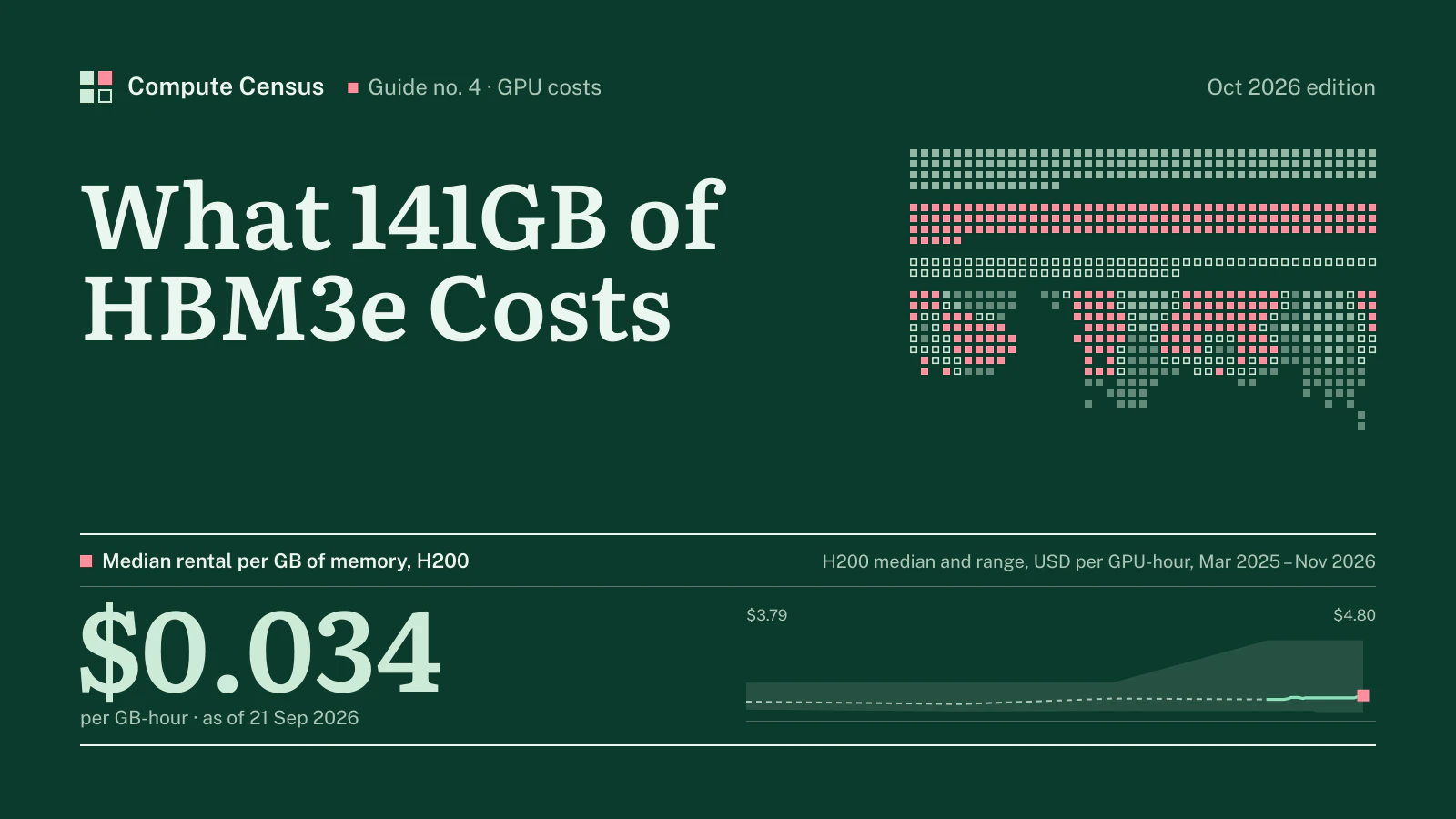
The NVIDIA H200 is an H100 with more and faster memory: 141 GB of HBM3e at 4.8 TB/s, against 80 GB in the H100, on the same Hopper compute. Its price is therefore best read as a price for memory. In the Compute Census index of 6 Nov 2026, the H200’s median on-demand rental is $4.80 per GPU-hour, against $3.90 for the H100. Per gigabyte of GPU memory, the H200 costs $0.034 per hour at the median and the H100 $0.049.
Buying one is harder to price. NVIDIA publishes no list price for the H200, and most units reach buyers inside complete servers on negotiated terms. Public listings are rare. One US reseller of refurbished data center hardware listed the H200 NVL, the PCIe version, at $39,995 per card in October 2026. Complete eight-GPU H200 servers are sold on quotes.
This guide prices the H200 from the memory outward: what the extra gigabytes do, what the rental market charges for them and why rates have risen, what ownership costs once power and hosting are counted, how the H200 compares with the H100 and the B200 for real jobs, and how US export rules shape its market. Every rental figure comes from our index and updates with it; every external figure is dated and listed on our Sources page.
What you pay for: memory, not compute
Same engine, bigger tank
NVIDIA describes the H200 as the first GPU to offer 141 GB of HBM3e memory at 4.8 TB/s, nearly double the capacity of the H100 with 1.4 times its memory bandwidth. The compute units are the same Hopper design. In practice that means the H200 runs the same software as the H100, at the same peak arithmetic rates, but holds much larger models and moves data in and out of memory faster.
For many AI jobs, memory is the binding constraint. Serving a large language model requires holding its weights plus a cache that grows with every user and every token of context. Training requires holding weights, gradients and optimiser state. When those do not fit on one GPU, the job is split across several, and the GPUs spend time exchanging data instead of computing. A part with more memory per GPU cuts that overhead.
Two versions, two power envelopes
The H200 comes in two forms, and their prices are not comparable without saying which is which.
- H200 SXM. The module for NVIDIA’s eight-GPU HGX baseboard. NVIDIA’s specification lists 900 GB/s of NVLink bandwidth and a maximum thermal design power of up to 700 W, configurable. It is the version inside most H200 servers and most rental offers.
- H200 NVL. A dual-slot, air-cooled PCIe card with the same 141 GB and 4.8 TB/s, a maximum power of up to 600 W, and two- or four-way NVLink bridges between cards at 900 GB/s per GPU. It fits ordinary servers and suits inference fleets that do not need the full eight-way fabric.
Both support up to seven Multi-Instance GPU partitions, at 18 GB each on the SXM and 16.5 GB each on the NVL. That matters for inference providers, who can split one H200 into several isolated slices and sell them separately.
In short, the SXM version sits on an eight-GPU HGX baseboard with 900 GB/s NVLink and a configurable power limit of up to 700 W. The NVL version is a dual-slot, air-cooled PCIe card with the same 141 GB of memory and 4.8 TB/s of bandwidth, a power limit of up to 600 W, and two- or four-way NVLink bridges between cards at 900 GB/s per GPU. NVIDIA lists HGX H200 systems with four or eight GPUs from partners and NVIDIA-Certified Systems, and MGX servers for the NVL card with up to eight.
Not to be confused with the GH200
One naming trap is worth a paragraph. The GH200 Grace Hopper Superchip is a different product: a Hopper GPU paired on one module with NVIDIA’s Arm-based Grace CPU and a large pool of CPU memory. Some clouds rent it alongside the H100 and H200; Lambda, for example, lists GH200 instances on its price page. It is a capable part for some workloads, but its memory layout, software platform and price are its own. A quote for “H200” should never turn out to be a GH200, or the reverse, and buyers comparing offers should check the model name exactly.
The premium per gigabyte
Set side by side, the index shows how the market prices the extra memory. The table compares the H200 with the H100 below it and the B200 above it, on the median rental, the 12-month reserved rate where published, memory per GPU and the median price per gigabyte of memory.
Table 1H200 between the H100 and the B200, USD per GPU-hour
| Model | Median | 12-mo reserved | Memory | Median per GB of memory | Providers |
|---|---|---|---|---|---|
| H100 | $3.90 | $3.26 | 80 GB | $0.049 | 11 |
| H200 | $4.80 | $3.40 | 141 GB | $0.034 | 9 |
| B200 | $6.90 | not published | 180 GB | $0.038 | 12 |
USD per GPU-hour, on-demand unless stated. Compute Census GPU price index of 6 Nov 2026.
The per-gigabyte line is the one that answers most buying questions. If a workload is limited by memory, the right comparison is price per gigabyte, not price per GPU, and the gap between the two parts on that measure is much smaller than the gap per GPU. CloudZero’s own guide to H100 prices frames the choice the same way: pay the H200’s rental premium when models are memory-bound, skip it when they are not.
The rental market for the H200
Who rents it, and at what price
The H200 is sold by most GPU clouds and all the large clouds, but on very different terms. Our index records 13 price points from 9 providers. The cheapest on-demand offer is $2.09 per GPU-hour and the most expensive $13.78, a spread of 6.6×.
Table 2H200 prices by provider, USD per GPU-hour
| Provider | Offer | USD / GPU-hr | As of |
|---|---|---|---|
| Jarvislabs | Spot | $1.99 | 2026-09-21 |
| Beam | Serverless | $2.09 | 2026-09-21 |
| Beam | On-demand | $2.09 | 2026-10-20 |
| GMI Cloud | On-demand | $2.60 | 2026-09-21 |
| Civo | Reserved, 12 mo | $3.19 | 2026-10-20 |
| DigitalOcean | Reserved, 12 mo | $3.40 | 2026-09-21 |
| Civo | On-demand | $3.49 | 2026-10-20 |
| Jarvislabs | On-demand | $3.99 | 2026-09-21 |
| GetDeploying median | Third-party index | $4.40 | 2026-09-21 |
| DigitalOcean | On-demand | $4.47 | 2026-10-20 |
| Runpod | On-demand | $5.29 | 2026-10-20 |
| Nebius | On-demand | $5.40 | 2026-10-20 |
| CoreWeave | On-demand | $6.31 | 2026-10-20 |
| Microsoft Azure | On-demand | $13.78 | 2026-09-21 |
Price points recorded by the Compute Census index for the H200; third-party index rows are context, not providers. Full table: H200 rental price.
Three bands are visible in the table. Serverless and marketplace-style sellers sit at the bottom, pricing spare capacity by the hour or by the second. GPU clouds and developer clouds sit in the middle: Civo listed the H200 SXM at $3.49 an hour on demand in October 2026, DigitalOcean its HGX H200 Droplet at $4.47, and Nebius its HGX H200 at $5.40. The large clouds sit at the top. Azure’s eight-GPU ND96isr H200 v5 virtual machine costs between $106 and $110.24 an hour depending on region, according to Spare Cores, or roughly $13 to $14 per GPU-hour.
What comes with an H200 instance
The GPU is only part of what an H200 rental buys, and providers bundle different amounts of everything else. Civo’s single-GPU H200 size, for example, comes with 23 vCPUs, 169 GB of system memory and 400 GB of NVMe storage, with data transfer marked free. DigitalOcean’s H200 Droplet comes with 24 vCPUs, 240 GiB of memory, a 720 GiB boot disk and a 5 TiB scratch disk, with a monthly transfer allowance. Hyperscaler instances come as eight-GPU machines with large amounts of CPU and memory, priced as one unit.
Those bundles matter more than they appear. A training job that streams data from storage needs fast local disks and enough CPU to keep the GPUs fed; an inference service that sends large responses to many users pays for data transfer. Two offers at the same hourly GPU rate can differ by a large margin once storage and transfer are added, and the cheapest GPU-hour is not always the cheapest job.
Term rates and reservations
Commitment lowers the price, and a few providers publish by how much. Civo’s twelve-month rate for the H200 SXM was $3.19 an hour, against $3.49 on demand. DigitalOcean’s twelve-month reserved H200 is $3.40 in our index, −29% against the on-demand median. At that rate, one H200 reserved for a year costs $2,482 a month, against $3,504 at the on-demand median.
AWS sells a different kind of reservation. Its EC2 Capacity Blocks reserve instances for a fixed window at a published price, and in October 2026 a p5en.48xlarge block with eight H200s cost $63.158 per instance-hour, or $7.895 per GPU-hour, in US East (Ohio) and most other regions. That is above the on-demand median but buys something the median does not: a guarantee that eight H200s on one fabric will be there for the dates booked. AWS had already cut its On-Demand price for P5en instances by 25% in June 2025, when it reduced GPU instance prices across its P4 and P5 families.
The price went up, not down
Hopper was expected to get cheaper as Blackwell arrived. It did not. SemiAnalysis, which runs its own rental price surveys, wrote in April 2026 that the prevailing expectation before late 2025 had been for H100 and H200 rental prices to drop considerably as Blackwell deployments ramped, and that the opposite happened. It reported that one-year H100 contract prices rose almost 40%, from a low of $1.70 per GPU-hour in October 2025 to $2.35 by March 2026, and that half the providers it asked for even eight nodes of H100s or H200s were sold out.
Figure 1H200: median on-demand rental price and published range, USD per GPU-hour, 2025-03-01 to 2026-11-06
Our own history shows the H200’s path. The median stands at $4.80 against $3.40 a year earlier, a change of +41%; the last move in the series was +3.0% on 6 Nov 2026. Prices for capacity that is actually available, as opposed to listed, have risen faster than published medians suggest, because sold-out providers keep their list prices unchanged.
Some providers did change their lists. Nebius, one of the larger GPU clouds, raised its prices twice in three months in 2026, with roughly 17% more for H100 instances and 21% more for B300 instances from 1 October, according to Silicon UK; the same report noted that CoreWeave said it was signing new contracts at higher prices. The H200 sits between those two parts, and buyers renting it should expect the same pressure at renewal.
What it costs to buy an H200
No list price
As with the H100, NVIDIA sells most H200s to server makers and large buyers on terms it does not publish. Every purchase figure in circulation is therefore a reseller listing, a buyer’s report or an analyst estimate, and each refers to a specific version and condition. CloudZero’s comparison table describes the H200’s purchase price as “quote-based premium”, which is an honest summary of the public evidence.
The clearest public price we found is a single listing. A US reseller of refurbished data center hardware with a standard three-year warranty, listed the H200 NVL 141 GB PCIe card at $39,995 in October 2026. That is one seller, one channel and one condition, not a market price, but it gives an order of magnitude for a single card. It is also the PCIe version, which buyers of training clusters rarely want.
A refurbished listing raises its own questions. “Refurbished” can mean a unit returned unused, a card pulled from a decommissioned cluster after years at full load, or anything between. The listing’s three-year warranty is the reseller’s, not NVIDIA’s, and its value depends on the reseller’s ability to replace a failed card quickly. A buyer of loose H200 cards should ask how each unit was tested, whether it carries any remaining manufacturer warranty, and what the replacement process is, before comparing the price with new hardware.
Servers and DGX systems
Most buyers of H200s buy eight at a time, on an HGX baseboard inside a server from Dell, Supermicro, HPE, Lenovo or others, or as NVIDIA’s own DGX H200. The DGX H100 and H200 share one chassis and one user guide: an 8U system drawing up to 10.2 kW from six 3,300 W power supplies in a 4+2 redundant layout, weighing up to 130.45 kg. Server prices for H200 systems are quoted per configuration and are not published in a form we can cite, so this guide prints no server price.
The arithmetic of a server quote is the same as for the H100. The eight GPUs are the largest line, then memory, network adapters, local storage and support. Our H100 price guide shows how far two servers with the same GPUs can differ once those lines are counted, and the same spread applies to H200 systems.
Depreciation and resale
An owner’s real cost depends on how long the hardware stays useful and what it is worth at the end. Accounting gives one answer: Meta has extended the estimated useful lives of most of its servers and network assets to 5.5 years, and Microsoft and Alphabet have moved to five or six years in their filings, according to IntuitionLabs’ review of those documents. Amazon, by contrast, shortened the estimate for part of its fleet. Those are bookkeeping estimates, not measurements of when a GPU fails or loses market value, but they show that the largest buyers expect years of service from each generation.
The resale market gives another answer. IntuitionLabs, quoting Compute Exchange’s indicative ranges, puts used H100 prices at roughly 60 to 70% of new-unit cost in the third quarter of 2026. There is no comparable public range for the H200 yet, because few units have reached the secondary market. If the H200 follows the H100’s path, an owner can expect to recover a meaningful share of the purchase price when the hardware is replaced, which lowers the effective cost per hour in the ownership table below.
What an H200 costs to run
Electricity
An H200 SXM can draw up to 700 W, the same ceiling as an H100 SXM, and the server around it draws more. SemiAnalysis’s model of large H100 clusters allows about 575 W of non-GPU server power per GPU, for CPUs, memory, network adapters, fans and conversion losses. The H200 runs in the same servers, so 1,275 W per GPU at the server is a reasonable working figure.
The facility adds its overhead. The Uptime Institute’s 2026 survey found an industry average power usage effectiveness of 1.52, and a capacity-weighted average of 1.36, because large facilities run more efficiently. The US Energy Information Administration reported an average industrial electricity price of 9.77 cents per kWh for July 2026. At 1,275 W, a PUE of 1.36 and that price, an H200 costs about 17 cents an hour in electricity while it runs: a small fraction of its rental price.
Hosting
Most owners lease space and power in someone else’s facility. CBRE’s North America report for the second half of 2025 gives an average asking rate of $195.94 per kW per month for 250 to 500 kW requirements in primary markets, up 6.5% in a year, with vacancy at a record low of 1.4%. At 1.275 kW per GPU, hosting adds about 34 cents per GPU-hour, paid whether the GPU works or not.
Owner’s cost against the rental market
The table below combines those inputs with the single public card price above, a $39,995 H200 NVL, to estimate an owner’s cost per GPU-hour actually used, by depreciation period and utilisation, and sets it against the index. It is deliberately conservative on one point: an SXM server would cost more per GPU than a loose PCIe card, and its power draw is higher.
Table 3Owner's cost per used H200 GPU-hour, by depreciation period and utilisation, USD
| Written off over | 100% use | 70% use | 50% use |
|---|---|---|---|
| 3 years | $2.03 | $2.83 | $3.90 |
| 4 years | $1.65 | $2.29 | $3.14 |
| 5 years | $1.42 | $1.96 | $2.68 |
| 6 years | $1.27 | $1.75 | $2.38 |
| Rent instead: index median, on-demand | $4.80 | $4.80 | $4.80 |
| Rent instead: 12-month reserved | $3.40 | $3.40 | $3.40 |
Inputs: H200 NVL 141GB PCIe card, US reseller listing, Oct 2026, $39,995 per GPU; 1275 W per GPU including its share of the server; PUE 1.36; electricity $0.0977 per kWh (electricity $0.169 per used hour); hosting $195.94 per kW per month ($0.342 per GPU-hour, paid whether the GPU works or not). Green = below the reserved rate, red = above the on-demand median. Not included: networking, storage, staff, financing, resale value. Rental rates from the Compute Census index of 6 Nov 2026.
Two lessons stand out. Utilisation dominates: an owner whose GPUs sit idle half the time pays nearly twice as much per used hour as one who keeps them busy. And depreciation period matters almost as much: the longer the hardware stays useful, the cheaper each hour becomes, which is why the H200’s resilience in the rental market is good news for owners.
Table 4Rented H200 time that adds up to one purchase (H200 NVL 141GB PCIe card, US reseller listing, Oct 2026, $39,995 per GPU)
| Rental rate | USD / GPU-hr | Hours to equal purchase | Months at 100% use | Months at 50% use |
|---|---|---|---|---|
| Floor, on-demand | $2.09 | 19,136 | 26.2 | 52.4 |
| 12-month reserved | $3.40 | 11,763 | 16.1 | 32.2 |
| Median, on-demand | $4.80 | 8,332 | 11.4 | 22.8 |
| Ceiling, on-demand | $13.78 | 2,902 | 4.0 | 8.0 |
Hours = purchase price ÷ rental rate; months = hours ÷ (730 h × utilisation). Rates from the Compute Census index of 6 Nov 2026. Power alone costs an owner about $0.169 per GPU-hour at 1275 W, PUE 1.36 and $0.098 per kWh, before servers, networking, space and staff.
The break-even table expresses the same comparison in time: how many hours of rental at each index price the purchase price would buy, before power and hosting. Read the median row first. It shows how many months of continuous rental the card’s price is worth; at half utilisation the period doubles, and an owner’s power and hosting costs come on top. A buyer who cannot keep the card busy for longer than that period, and then keep it useful for years after, is better off renting.
When the H200 pays off
Memory-bound inference
The strongest case for the H200 is inference on large models. Serving needs room for the model’s weights and for a key-value cache that grows with every user and every token of context. For long-context applications the extra memory translates directly into more users or longer conversations per GPU, and into simpler serving, because fewer GPUs have to cooperate on each request.
It depends on whether the work is limited by memory. A model that needs two H100s to hold its weights and cache may fit on one H200, which halves the GPUs needed and removes traffic between them. For work that fits comfortably in 80 GB, the H100 does the same job for less.
How many users per GPU
For an inference service, the useful measure is not the price per GPU-hour but the price per user or per million tokens served. Memory sets how many requests a GPU can hold at once: each active conversation keeps its own cache in GPU memory, and the cache grows with the length of the context. A GPU with more memory can hold more conversations or longer ones before requests have to wait or be moved to another GPU.
That is why the H200’s premium per GPU-hour can translate into a lower cost per user. If 141 GB lets a service hold substantially more concurrent requests than 80 GB, the cost per request falls even though the hourly rate rises. The exact ratio depends on the model, the context length and the serving software, and providers and model developers publish few comparable figures. The way to settle it is to benchmark the actual model on both parts for a day, which costs far less than committing to the wrong one for a year.
Training
For training, the case is weaker. Large training runs are split across hundreds or thousands of GPUs anyway, and the H200’s compute is the same as the H100’s. More memory per GPU can reduce the parallelism needed and improve efficiency, but the larger gains come from moving to Blackwell, which adds compute as well as memory. The B200’s median in our index is $6.90 per GPU-hour with 180 GB of memory; for a training run that can use Blackwell’s speed, it often delivers more work per dollar than either Hopper part.
The H200 against its neighbours
A simple rule follows from the index. If the job fits in 80 GB, rent H100s. If it needs more memory per GPU but no more compute, rent H200s, and compare them on price per gigabyte. If it needs more compute, look at the B200 and price the job, not the GPU-hour. Monthly costs at the median for each part make the decision concrete.
In practice the decision usually falls into one of four patterns:
- Chat and assistant services on large models, with long conversations and many concurrent users: memory-bound, a natural fit for the H200.
- Retrieval-augmented and long-document workloads, where context length drives the cache: also memory-bound, and the H200’s 4.8 TB/s of bandwidth helps as much as its capacity.
- Fine-tuning and training of mid-sized models: often compute-bound; the H100 is cheaper per hour and the B200 faster per job.
- Batch inference on small models: neither part’s memory is the constraint, and older or smaller GPUs may do the work for a fraction of the price.
Table 5Memory-heavy options in the index, USD
| Model | Median | Median × 730 h | Memory | Median per GB of memory |
|---|---|---|---|---|
| H100 | $3.90 | $2,847 | 80 GB | $0.049 |
| H200 | $4.80 | $3,504 | 141 GB | $0.034 |
| B200 | $6.90 | $5,037 | 180 GB | $0.038 |
| MI300X | $2.99 | $2,183 | 192 GB | $0.016 |
USD per GPU-hour, on-demand unless stated. Compute Census GPU price index of 6 Nov 2026.
The MI300X belongs in that comparison. AMD’s part carries 192 GB per GPU and rents for $2.99 at the median, so on price per gigabyte it competes directly with the H200 for memory-bound inference, provided the software stack runs on AMD.
Export rules and the China market
From denial to case-by-case review
The H200’s market is shaped by US export controls more than most. For years, chips of its class could not be exported to China without a licence that would normally be denied. On 15 January 2026, the Bureau of Industry and Security published a rule changing its licence review policy for exports of certain semiconductors to China and Macau from a presumption of denial to case-by-case review. The rule names the NVIDIA H200 and its equivalents, as well as less advanced chips, and gives the AMD MI325X as another example of a covered part.
The change comes with conditions. Covered chips must be commercially available in the United States when the rule was published, and the exporter must certify that US supply is sufficient, that production for China will not divert foundry capacity from US customers, that the recipient has adequate security procedures, and that the item undergoes independent third-party testing in the United States to verify its specifications. The rule also caps volume: the aggregate processing performance of such chips exported to China or Macau may be no more than 50 percent of what is shipped to customers in the United States for US end use.
Why it matters for buyers elsewhere
Since 15 January 2026, the Bureau of Industry and Security reviews licence applications for the H200 and equivalent chips to China and Macau case by case, instead of presuming denial, subject to conditions certified by the exporter. For buyers outside China, the effect is indirect but real: a new source of demand for a part whose supply was already tight. CloudZero’s guide notes that the January 2026 shift permitting conditional H200 sales to China added a demand source mid-cycle, at the same time as the rental shortage SemiAnalysis described.
The rules for other destinations changed too. In May 2025 the Department of Commerce rescinded the previous administration’s AI Diffusion Rule, which would have sorted countries into tiers with different access to advanced chips from 15 May 2025, and said it would issue a replacement rule. Buyers outside the United States should check the current licence requirements for their country with their supplier before ordering, because they decide delivery times as much as factory supply does.
Export rules also affect the secondary market. Used and refurbished H200s, like new ones, remain controlled items, and a reseller’s listing does not settle whether a given buyer in a given country may receive them. Reputable sellers ask for end-user information before shipping; a seller who does not is a risk in itself.
How the figures on this page are built
Every rental number on this page comes from the Compute Census index, which records published prices from providers’ own pages and from comparison trackers, dates each one and computes a floor, a median and a ceiling per model. The median is the typical published rate, not the price of capacity you can necessarily book today; when providers are sold out, their list prices stay where they are while real availability disappears. The 12-month reserved figure is a published term rate, used only where a provider states one.
External figures — specifications, purchase listings, electricity prices, facility efficiency, hosting rates and regulations — come from the documents listed on our Sources page, each with the date we read it. The ownership tables combine those cited inputs with the index; they are arithmetic, not forecasts, and they leave out financing, staff, insurance and networking, which an owner must add. Where a figure is not published, such as the price of a complete H200 server, this page says so rather than estimating it.
Comparing two H200 quotes
Suppose two providers quote H200 capacity for the same job. The first offers a lower hourly rate per GPU on single-GPU instances with storage billed separately; the second quotes a higher rate for whole eight-GPU servers on a dedicated fabric, with local NVMe and data transfer included. The first looks cheaper and may be, for an inference service that scales one GPU at a time. For a fine-tuning job that needs eight GPUs talking to each other and reads terabytes of data, the second may finish faster and cost less in total.
The way to compare them is to price the job, not the hour: the number of GPU-hours the job needs on each configuration, plus storage, transfer and support, over the length of the commitment. Ask each provider for the same configuration on paper before deciding, and treat a quote that cannot specify the server, the fabric and the delivery date as incomplete.
How to source H200 capacity
Decide between rental and ownership
Start with the workload and its horizon. A memory-bound inference service that will run for years on stable models is a candidate for ownership, if a site with the power and cooling is available. A training project, a product still searching for its model size, or any workload with uncertain demand is better served by renting, and by renting on terms that allow moving to Blackwell when the job grows.
Questions for a seller of H200 hardware
- Is it the SXM version on an HGX baseboard or the NVL PCIe card?
- New or refurbished, with what warranty and service history?
- What is in the server besides the GPUs, and what is the lead time?
- What export paperwork applies to the destination country?
- Where will it be hosted, and is that power contracted today?
Questions for a provider of rented H200s
- Is the price for dedicated nodes, slices, spot or serverless capacity?
- What is the minimum term, and what is the exit?
- Which fabric links the nodes, and at what speed per GPU?
- What happens when a node fails, and how fast is it replaced?
- What does it cost to store and move the data?
We handle both routes. H200 capacity is available for rent and hardware for purchase, through different partners, and the terms are agreed individually for each request. Tell us the version, quantity, location and timing in the form below, and we come back with what is available and on what terms.