The short answer
Yes, there is still a GPU shortage, but it is not the one most people remember. The consumer-card shortage of 2020 and 2021 came from crypto mining and pandemic logistics, and it ended. The data center shortage is a different thing. It has no single shortfall of chips behind it. It is a shortage of finished, powered, networked capacity that can be switched on this quarter.
For data center GPUs, yes, in the sense that matters to a buyer: capacity is hard to get on short notice, and prices have stopped falling. SemiAnalysis reported in April 2026 that on-demand capacity was sold out across all GPU types. Half of the providers it asked had no room for an eight-node, 64-GPU H100 or H200 cluster. Most reported no Hopper capacity coming off contract, and H100s were being renewed at the rates signed two to three years earlier, some of them through 2028.
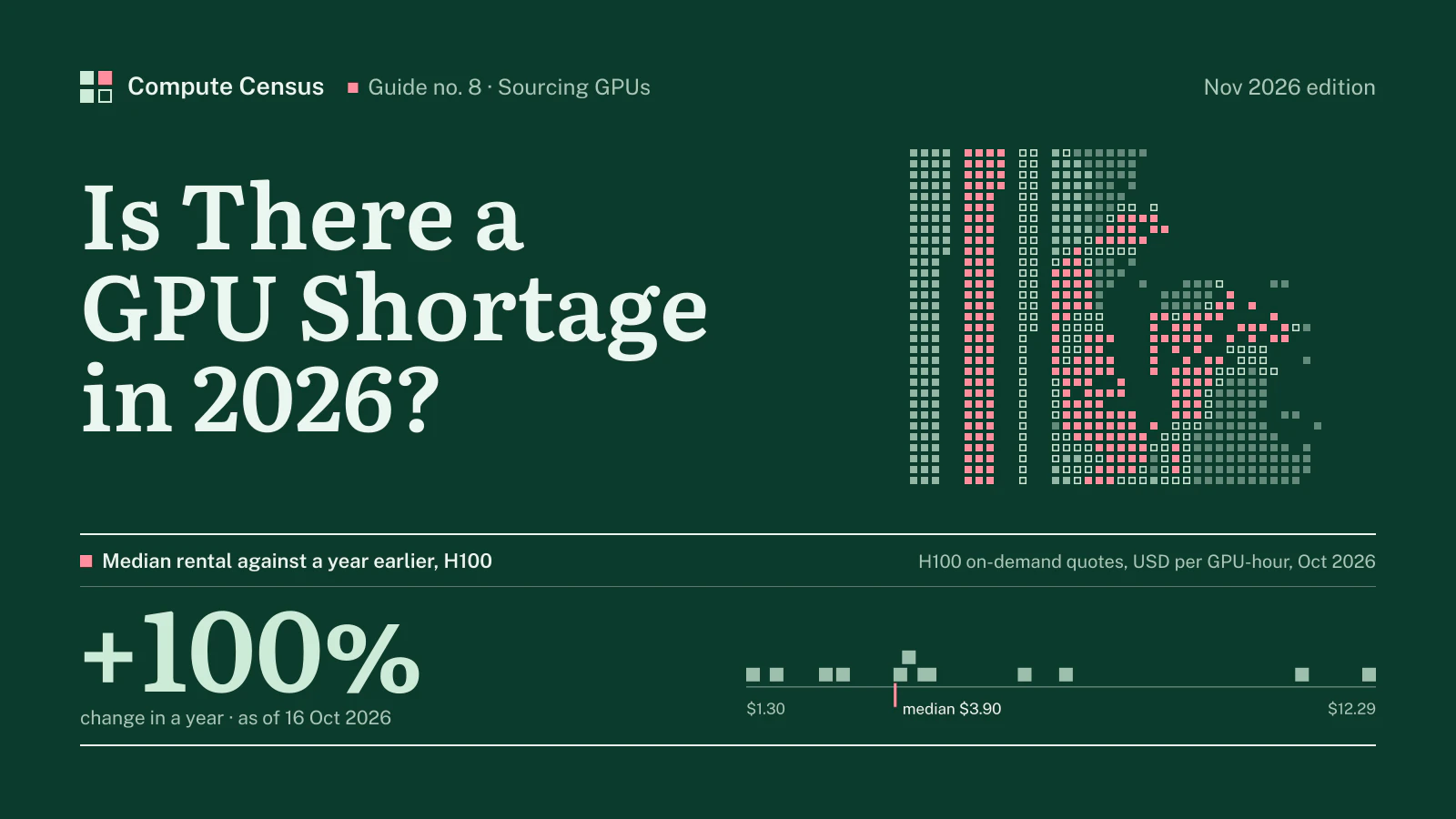
Our own index shows the same turn. At the 6 Nov 2026 snapshot the median on-demand price of an H100 is $3.90 per GPU-hour, and it has moved +100% against 1 Oct 2025. Through most of 2024 and 2025 the direction was the other way, which is why the change surprised so many buyers.
The rest of this guide separates the claims that can be checked from those that cannot. We take the rental evidence first, then lead times, then the four physical limits: packaging, memory, servers and power. We close with what a buyer can do about it. Every external number is dated, attributed and listed on our Sources page. Every rental number comes from our price index and updates when the index does.
What “shortage” means for data center GPUs
Two different markets under one word
Search results for “GPU shortage” mix two things. One is the retail graphics-card market, where gamers wait for a release and pay above list. The other is the market for data center accelerators: the H100, H200, B200 and their successors, sold as eight-GPU servers or rented by the hour. This guide covers the second. It follows the territory of our price index, not the shelves of a shop.
The two markets share a manufacturer and, increasingly, a set of suppliers. They do not share a buyer. A data center GPU is bought by a few hundred organisations that sign multi-year commitments, and it is bought as part of a system that needs a building, a power contract and a network before it earns anything.
The 2023 shortage and the 2026 shortage
The first data center shortage peaked in 2023. Dell quoted a 39-week lead time for H100 servers in late 2023, according to The Register, and the whole server industry was quoted at 36 weeks to a year by Omdia. The bottleneck then was clear and single: TSMC’s CoWoS advanced packaging line, which TSMC said in September 2023 could meet only 80 percent of orders.
By April 2024 Dell’s lead time had fallen to eight to twelve weeks. HPE reported about 20 weeks in March 2024, though it said it had lost GPU sales while it waited. The shortage looked solved. Rental prices fell for the next year and a half, and many buyers drew the conclusion that scarcity belonged to the past.
The 2026 shortage has a different shape. Packaging has expanded. What binds now is a stack of constraints, none large enough alone to explain the market and all of them present together. The honest summary is that the supply of GPUs has grown, and the demand for useful compute has grown faster.
What a shortage looks like in the data
A shortage shows up in four measurable places. Rental prices stop falling or rise. Providers sell out of on-demand capacity and ask customers to commit. Lead times for new hardware lengthen. Old hardware keeps its value. We found evidence of all four in 2026, and each is covered below, starting with the one we measure ourselves.
What the rental index shows
The turn in the median
The rental price is the fastest signal, because it moves with every provider’s price list rather than with annual contracts. The Compute Census index records published per-hour prices across providers, and it counts 11 providers with an H100 price at this snapshot.
Figure 1H100: median on-demand rental price and published range, USD per GPU-hour, 2023-06-01 to 2026-11-06
Compare the figure with the earlier part of the series. The H100 median stood at $8.00 when our record starts on 1 Jun 2023, reached $8.00 at its peak on 1 Jun 2023 and stands at $3.90 now. The latest recorded move in the series, +1.8%, was dated 6 Nov 2026.
We say nothing about direction here beyond what those numbers state, because the index updates and the sentence should stay true when it does. What the history shows, read against the external reports below, is a market in which the long decline of Hopper rental prices ended during the past year.
What the survey indices say
SemiAnalysis publishes a contract-price index built from a survey of more than 100 market participants, and it updates monthly. Its one-year H100 contract rate rose from a low of $1.70 per GPU-hour in October 2025 to $2.35 by March 2026. It broke above $2 in late January 2026 and rose another 15 to 20 percent between end-January and mid-to-late February.
Our index and that survey measure different things. Ours records published prices from provider price lists, mainly for on-demand and reserved offers. Theirs records what buyers say they signed for a year. When two different methods turn at the same time, a reader should treat the turn as real, even if the exact size differs.
Providers raising list prices
The clearest sign is a provider changing its price card. Nebius raised its on-demand rates from 1 October 2026: roughly 17 percent for H100 instances and 21 percent for B300 instances, according to Silicon UK. The B300 had risen 56 percent cumulatively across two increases in three months. The same report noted that CoreWeave said, on the same day, that it was signing new contracts at higher prices.
CoreWeave’s own release of 17 September 2026 says it has “continued to contract new compute capacity at higher prices” since the end of June. It signed short-dated contracts of about three to six months in the third quarter of 2026 at roughly $40 million per megawatt of annualised revenue, and added more than $25 billion of net new customer commitments early in the quarter. The company does not give a prior-period price, so the size of the increase is not published.
AWS shows the same thing from a different angle. It says it updates Capacity Block prices regularly to reflect supply and demand, and it lists an eight-GPU H100 instance at $47.757 per instance-hour, which is $5.970 per GPU-hour. The same page lists $6.866 per GPU-hour for one H200 instance type, $7.895 for another, and $14.208 per GPU-hour for the eight-GPU B200 instance. A block is charged at the rate in effect when it is bought, and the next scheduled update is January 2027.
The ladder between the floor and the ceiling
A single median hides the shape of a tight market. When capacity is short, the spread between the cheapest and the dearest offer widens, because the cheapest offers disappear first and the expensive ones remain. At this snapshot the ceiling of our H100 quotes sits 9.5× above the floor.
Table 1H100 prices by provider, USD per GPU-hour
| Provider | Offer | USD / GPU-hr | As of |
|---|---|---|---|
| Lium.io | Marketplace | $1.30 | 2026-09-21 |
| Beam | On-demand | $1.83 | 2026-10-20 |
| CoreWeave | Spot | $2.46 | 2026-10-20 |
| Runpod | On-demand | $2.69 | 2026-10-16 |
| Civo | Reserved, 12 mo | $2.69 | 2026-10-20 |
| Civo | On-demand | $2.99 | 2026-10-20 |
| DigitalOcean | Reserved, 12 mo | $3.26 | 2026-09-28 |
| Runpod | On-demand | $3.99 | 2026-10-16 |
| Lambda | On-demand | $3.99–$4.29 | 2026-10-16 |
| DigitalOcean | On-demand | $4.41 | 2026-10-20 |
| Nebius | On-demand | $4.50 | 2026-10-16 |
| CoreWeave | On-demand | $6.16 | 2026-10-20 |
| AWS | On-demand | ~$6.88 | 2026-10-16 |
| Google Cloud | On-demand | ~$11.00 | 2026-10-16 |
| Microsoft Azure | On-demand | $12.29 | 2026-10-16 |
Price points recorded by the Compute Census index for the H100; third-party index rows are context, not providers. Full table: H100 rental price.
The table is worth reading provider by provider. Marketplace offers at the bottom are often single-host, short-notice capacity. Dedicated clusters from neoclouds sit in the middle. Hyperscaler list prices sit at the top. A buyer who needs a large block cannot buy at the floor, because the floor is made of small lots.
Beyond Hopper: Blackwell and the newer parts
Allocation instead of price
For Blackwell the problem is less about price and more about allocation. SemiAnalysis said lead times for new Blackwell deployments extended into June and July 2026 and that all capacity coming online through August and September 2026 was already booked. It reported customers competing to pay $14 an hour per GPU for AWS B200 spot instances, which matches the Capacity Block rate quoted above.
IntuitionLabs, citing Electropages, gave lead times of three to seven months for Blackwell-class parts in early 2026. It cites new B200 cards at $30,000 to $50,000 each. NVIDIA’s chief executive said in March 2024 that Blackwell would cost between $30,000 and $40,000 per unit, so the card-level price range has not moved far from the original statement. The shortage shows up in waiting time, not in the sticker.
Reading our GPU comparison
Table 2Hopper and Blackwell in the rental index, USD per GPU-hour
| Model | Median | 12-mo reserved | Memory | Median per GB of memory | Providers |
|---|---|---|---|---|---|
| H100 | $3.90 | $3.26 | 80 GB | $0.049 | 11 |
| H200 | $4.80 | $3.40 | 141 GB | $0.034 | 9 |
| B200 | $6.90 | not published | 180 GB | $0.038 | 12 |
| GB200 | $13.25 | $10.58 | 186 GB | $0.071 | 5 |
USD per GPU-hour, on-demand unless stated. Compute Census GPU price index of 6 Nov 2026.
The number of providers in the last column matters as much as the price. A model with few providers is a thin market: one provider changing its mind moves the median. The newest parts have the fewest providers, so their medians are the least stable numbers in this guide.
Older parts
Scarcity spreads downward. When the newest GPUs are booked, buyers fall back on the previous generation, and the previous generation’s prices follow. The H100 has behaved this way, and the A100 and L40S are worth watching for the same reason. Our guide to the NVIDIA A100 price covers an older part where the market is deeper and supply is easier.
Lead times: what is published and what is not
The figures in circulation
Search for “data center GPU lead time” and you find the same few ranges. Reseller guides quote 36 to 52 weeks for H100 SXM5 systems, 8 to 16 weeks for the A100 80GB and 2 to 8 weeks for the L40S. Spheron’s 2026 guide gives those figures, and it describes them as channel estimates, not numbers published by NVIDIA or its server partners. The same page gives two different ranges for the H100, which tells you how loosely they are held.
Nobody with first-hand knowledge publishes a current figure. Reseller guides quote 36 to 52 weeks for H100 systems, one trade report gave three to seven months for Blackwell-class parts in early 2026, and SemiAnalysis said new Blackwell deployments extended into June and July 2026.
We take the rule that a lead time is useful only when its owner is named and the date is stated. By that rule, the figures we can stand behind are few. Dell’s 39 weeks in late 2023 and eight to twelve weeks in April 2024 are real, dated and attributed. For 2026 we found no equivalent published by a server maker. The statement that new Blackwell deployments extended into June and July 2026 comes from SemiAnalysis, which is a named source with a date.
Why quoted lead times mislead
A lead time is a statement about a particular configuration at a particular moment, and it can mean three different things. It can mean the time from order to delivery of a standard server. It can mean the time until a cluster is racked, networked and handed over. Or it can mean the time until the buyer’s allocation of a scarce part arrives, which is a promise and not a schedule.
Cluster buyers care about the second meaning, and it is the one that has stretched. A server can leave the factory on time and then wait for a hall with enough power. SemiAnalysis said OEMs repriced AI servers above the rise in component costs, which led some operators to delay or abandon deployments. That is a price effect on lead times that no published weeks figure captures.
How to use the numbers
Treat any single lead time as an upper-level hint. Ask your supplier for the date of the confirmation, the exact configuration and what happens if the allocation slips. A supplier who will not put a delivery window in writing has told you something about the real lead time. The H100 guide on this site, NVIDIA H100 price, lists the questions to ask a seller of hardware and a provider of capacity.
The four limits on supply
Four things limit supply at once: advanced packaging at TSMC, high-bandwidth memory, finished servers and, above all, powered buildings to put them in. Each has its own owner, its own timetable and its own published evidence, so we take them one at a time.
Limit one: advanced packaging
CoWoS, TSMC’s chip-on-wafer-on-substrate packaging, joins a GPU die to its memory stacks. It was the binding constraint in 2023, and TSMC has expanded it since. TrendForce’s summary of TSMC’s May 2026 technology symposium says TSMC forecasts CoWoS capacity to grow at a compound annual rate above 80 percent from 2022 to 2027, and that demand for AI accelerator wafers is projected to grow 11-fold between 2022 and 2026.
Those two numbers describe a race. Capacity compounding above 80 percent a year is extraordinary by any normal measure, and demand growing by an order of magnitude is faster still. TSMC does not publish a CoWoS wafer count. Analyst estimates quoted by Spheron put 2025 capacity at 70,000 to 80,000 wafers a month and the end of 2026 at 120,000 to 140,000, with the gap between supply and demand narrowing from about 20 percent to about 10 percent, according to TrendForce as cited there. We cannot verify those against the originals, so we show them as estimates, not facts.
Limit two: high-bandwidth memory
Every data center GPU carries stacks of HBM, and the memory makers have said they cannot fill all of the demand. A summary of Micron’s June 2026 results quotes its chief executive saying the company can meet only between half and two-thirds of customer demand, and that its entire 2026 HBM supply was sold out under multi-year contracts. The summary also reports Micron’s fiscal third-quarter revenue at nearly $42 billion, against $9 billion a year earlier. We treat that page as a secondary source and recommend reading Micron’s own filings for the exact figures.
Memory shortages spread beyond the GPU. SemiAnalysis reported that memory contract prices for LPDDR5 and DDR5 were tracking toward roughly four and five times the previous year’s level in the first quarter of 2026. That raises the price of the host server around the GPU, as well as of the GPU itself. A buyer comparing a server quote from last year with one from this year is comparing different memory markets.
Limit three: finished servers
A GPU is not a product until it sits in a server with a network. Server makers have to buy the memory, the CPUs, the network cards and the power supplies, and in 2026 several of those parts are short at once. SemiAnalysis said OEMs repriced AI servers above component cost increases. Its authors also cited tight TSMC N3 logic wafer capacity and shortages of HBM, DRAM and NAND.
For the buyer, this means a hardware quote is perishable. A price quoted in spring may not hold in autumn, and a shipping date can move with the availability of the cheapest part in the box. Rent-or-buy arithmetic done once and filed away is out of date within a quarter.
Limit four: powered buildings
The last limit is the one that lasts longest. A GPU needs a hall to run in, and the hall needs a grid connection. CBRE reports that primary-market vacancy in North America ended 2025 at a record low of 1.4 percent. Net absorption reached a record 2,497.6 MW in 2025, up from 1,809.5 MW in 2024. CBRE also reports that grid power for existing projects is largely booked through 2030 in most markets, and that sites with power access within 18 to 36 months are highly sought after.
Capacity under construction told a quieter story. It stood at 5,994.4 MW at the end of 2025, down from 6,350.1 MW a year earlier, which CBRE describes as the first decline since 2020. Demand set records while supply under construction fell back. That combination is how a shortage forms.
The next section sets this in context with the campuses we count.
Power: the shortage under the shortage
The census view
A GPU shortage is partly a power shortage, and power is the part we can count. Our census of AI data center campuses, taken from public records, lists 665 campuses in 56 countries as of 15 Nov 2026. The campuses that publish a capacity add up to 97.9 GW, of which 9.1 GW is operational, 51.1 GW is under construction and 37.6 GW is announced.
Table 3AI campuses in the census by status and published capacity
| Status | Campuses | With published MW | Published MW |
|---|---|---|---|
| Under construction | 259 | 227 | 51,090 |
| Announced | 131 | 111 | 37,645 |
| Operational | 275 | 158 | 9,132 |
Compute Census AI campus census, records to 15 Nov 2026. MW summed only where a source publishes a figure. Full list: AI data center census.
The table matters for a particular reason. Capacity that is only announced does not help a buyer who needs GPUs this quarter. The gap between what has been announced and what is operating is the delay a shortage is made of.
Why power sets the pace
Each generation of GPU draws more power per rack. Our guide to AI data center power consumption covers the numbers. The relevant point here is that a buyer who has the hardware and not the building has a stranded asset. CoreWeave’s contracted power rose from about 3.7 GW at the end of June 2026 to about 4.2 GW on 11 August 2026, which is a rise of about half a gigawatt in six weeks. It is a useful scale: one neocloud added that much power commitment in a quarter, and the whole census lists 27 single campuses of a gigawatt or more.
SemiAnalysis describes large offtakes of 50 MW to 100 MW as equal to roughly 24,000 to 48,000 GB300 NVL72 GPUs. By that conversion, a few such deals use up a meaningful part of any single market’s available power. When these deals are signed years ahead, small buyers meet the gap in the spot market.
Why the shortage is not evenly spread
A shortage of powered capacity is local. Northern Virginia led North American absorption in 2025 with 1,102.0 MW, and Dallas took 470.8 MW, according to CBRE. A buyer willing to place GPUs in a smaller market, or to rent in a region with free power, may find capacity that a buyer fixed on Northern Virginia cannot. The cost is network latency and data movement, which matter more for inference than for batch training.
Table 4Countries with the most published AI campus capacity
| Country | Campuses | With published MW | Published MW |
|---|---|---|---|
| United States | 239 | 156 | 54,363 |
| Australia | 31 | 27 | 8,259 |
| India | 55 | 44 | 8,192 |
| Indonesia | 31 | 29 | 4,788 |
| Malaysia | 30 | 25 | 3,935 |
| Japan | 23 | 21 | 2,298 |
| Canada | 19 | 11 | 2,013 |
| Thailand | 19 | 17 | 1,949 |
Compute Census AI campus census, records to 15 Nov 2026. MW summed only where a source publishes a figure. Full list: AI data center census.
Who is buying: demand in 2026
The supplier’s own numbers
NVIDIA reported data center revenue of $89.0 billion for the quarter that ended on 26 July 2026, up 117 percent from a year earlier and 18 percent from the previous quarter. Total revenue was $96.2 billion. Its guidance for the next quarter is $108.0 billion, plus or minus 2 percent, and it assumes no data center compute revenue from China. The Vera Rubin platform is in what NVIDIA calls full production, with racks running at CoreWeave, Google Cloud, Microsoft Azure, Oracle Cloud Infrastructure and Nebius.
Those numbers show supply growing at a pace that would have been unthinkable three years ago. A shortage that persists while the main supplier more than doubles its revenue in a year means demand rose even faster. It also means a rising share of the supply is going to the largest buyers first.
What drives the demand
SemiAnalysis lists the drivers it sees behind the 2026 squeeze: adoption of coding agents and large reasoning models, open-weight models such as GLM and Kimi K2.5, capital raises by AI labs, native media-generation tools and multi-agent workloads that run many steps at high concurrency. It reported that Anthropic’s annualised revenue had risen from about $9 billion at the end of 2025 to more than $30 billion. We have not verified the last figure against a company statement, and we report it as the newsletter’s claim.
The common thread is inference. Training a model is a project with an end date. Serving a model is a standing load that grows with the number of users, and it needs GPUs running around the clock. That changes the character of the market from bursts of demand to a floor that keeps rising. Our guide to renting a GPU explains how to match each kind of job to each kind of offer.
Contract length as a signal
SemiAnalysis divides the market into short-term capacity of under three months, mid-term capacity of three months to three years and long-term offtakes of four to five years, with five years the most popular. The longer the average contract, the less capacity reaches the spot market. When Hopper capacity is renewed rather than released, the on-demand pool shrinks even if the total number of GPUs in the world grows. That is the mechanism behind a rise in the index with no change in the number of chips made.
When will GPU prices drop?
What would have to change
Prices fall when supply catches up, demand slows or a cheaper generation displaces the old one. All three have happened before in this market, and the 2024 fall in Hopper rents was the third kind. Each has a published signal, and none currently points to a near-term fall.
Supply growth is real but is held by memory and power. Micron’s chief executive said, according to the summary quoted earlier, that DRAM and NAND demand significantly exceeds supply and will stay tight beyond calendar 2027. Nothing in the published supply data points to a drop before 2027. Micron says memory stays tight beyond calendar 2027 and CBRE says grid power for existing projects is largely booked through 2030.
Demand shows no sign of slowing in NVIDIA’s guidance, and the supplier’s own forecast is for further growth in the next quarter. The third route, a new generation displacing the old, is the one most likely to move prices in the next two years, and it takes the form of new hardware being delivered, not a policy.
Reasons for caution about forecasts
We do not publish a forecast, because the evidence does not support one. A single provider announcement, an export-rule change or a large cluster coming online can shift the market in a month. The rental market responded to the arrival of Blackwell in 2025 by falling, and it responded to the sell-out of 2026 by rising. A reader who must plan should plan for both directions and commit only to what the budget can hold.
What the rental index can and cannot tell you
Our index shows where published prices stand and how they have moved. It cannot show prices that providers negotiate privately, and it cannot show capacity that is unavailable at any price. If a price list says an H100 costs a given amount per hour and no node is free, the price is a fiction. Use the index to size a budget, then ask for a firm quote for the block you need.
How the shortage changes rent-or-buy
Renting is faster, but not instant
Renting is usually faster, but not instant. A rented block still depends on a provider having free, powered capacity, and in 2026 half of the providers SemiAnalysis surveyed were sold out for an eight-node cluster. Buying faces the same constraint one step earlier, because a server also needs a hall.
The practical difference lies in who carries the risk of waiting. A renter who cannot find capacity pays nothing and loses time. A buyer who has paid for servers that cannot be installed loses time and carries an asset that depreciates while it sits in a warehouse. Our H100 price guide works through the numbers of ownership.
Reserved contracts in a tight market
When on-demand capacity is scarce, a reserved contract becomes a way of securing supply as well as a discount. At this snapshot the published 12-month reserved H100 rate stands −16% against the on-demand median. The commitment is the price of access. A buyer should read the terms on what happens if the provider cannot deliver the nodes, how failed nodes are replaced and whether the price can be reset during the term.
Our guide to neoclouds lists the providers that sell dedicated capacity in this market and how their offers differ from the hyperscalers’.
Secondary-market hardware
The used and refurbished market is where buyers look when new lead times lengthen. It offers immediate availability, at a premium or with a warranty gap. IntuitionLabs cites used H100 prices well below the late-2023 peak. It is a reasonable route for a buyer who can operate hardware without a vendor, and a poor one for a buyer who cannot.
Whatever the route, normalise every quote to the same unit before comparing it. A price for a server is not a price for a GPU, a PCIe card is not an SXM module, and a hyperscaler list price is not what a large customer pays.
How to buy capacity in a tight market
Decide how flexible you are
The cheapest way to get capacity in a shortage is to need less of it, or later, or somewhere else. Ask four questions before sending any request. Can the job run on the previous generation? Can it run in another region? Can it start in six weeks rather than next week? Can it be split across smaller blocks? Each yes widens the supply you can draw on, and supply is the scarce good.
Build a request that suppliers can answer
Suppliers answer specific requests faster than vague ones. State the GPU model and form factor, the number of GPUs, the region and the latency you can accept, the start date and the term, and whether the network between nodes must be non-blocking. Say whether you need a dedicated node or can use shared capacity. Say what you will do if the supplier can offer only part of the block.
Separate the rent request from the purchase request. GPU capacity is available for rent and hardware for purchase, through different partners, and the terms are agreed individually for each request. We do not publish a fixed commission or a fixed minimum order, because neither exists.
Beware of the too-good offer
Shortages attract bad offers. A price far below the index for a large block of a scarce GPU deserves a question about where the hardware is, who owns it and whether the seller can show it. Ask for the serial numbers, the host location and the export paperwork before you pay. A real supplier expects these questions and answers them without fuss.
Check the facility before the hardware
If you buy hardware, secure the hall first. The most expensive mistake in a power-short market is to own servers that have nowhere to run. Ask the hosting provider for the date on which your power is contracted, not the date on which it is planned. For prices of the space itself, wattandrack.com tracks colocation offers per kW.
Tell us what you need
We can help with both routes. Use the form below to tell us the model, quantity, region, timing and whether you want to rent or buy. We come back with what is available and on what terms, and we say plainly when the answer is that nothing fits yet.