The short answer
An NVIDIA B200 has no list price. NVIDIA sells its data center GPUs to server makers and large customers on negotiated terms, so every figure in circulation is a statement, an estimate or a reseller’s listing. The most quoted number comes from the company’s own chief executive. In March 2024 Jensen Huang told CNBC that a Blackwell chip would cost between $30,000 and $40,000 per unit, and said NVIDIA had spent roughly $10 billion on research and development for it. That was a remark about the chip, not a price list for the card you can order.
What buyers actually order is a server with eight of them. Deploybase, a price tracker, put on-premises DGX B200 systems at $275,000 to $300,000 as of March 2026. Listings from resellers can sit far above that: the British builder Broadberry listed a Blackwell DGX B200 at $515,410.43 in October 2024. The gap between those two figures is the first lesson of this guide: a B200 “price” depends on who sells it, when, with which network cards, memory and support contract, and how many are ordered.
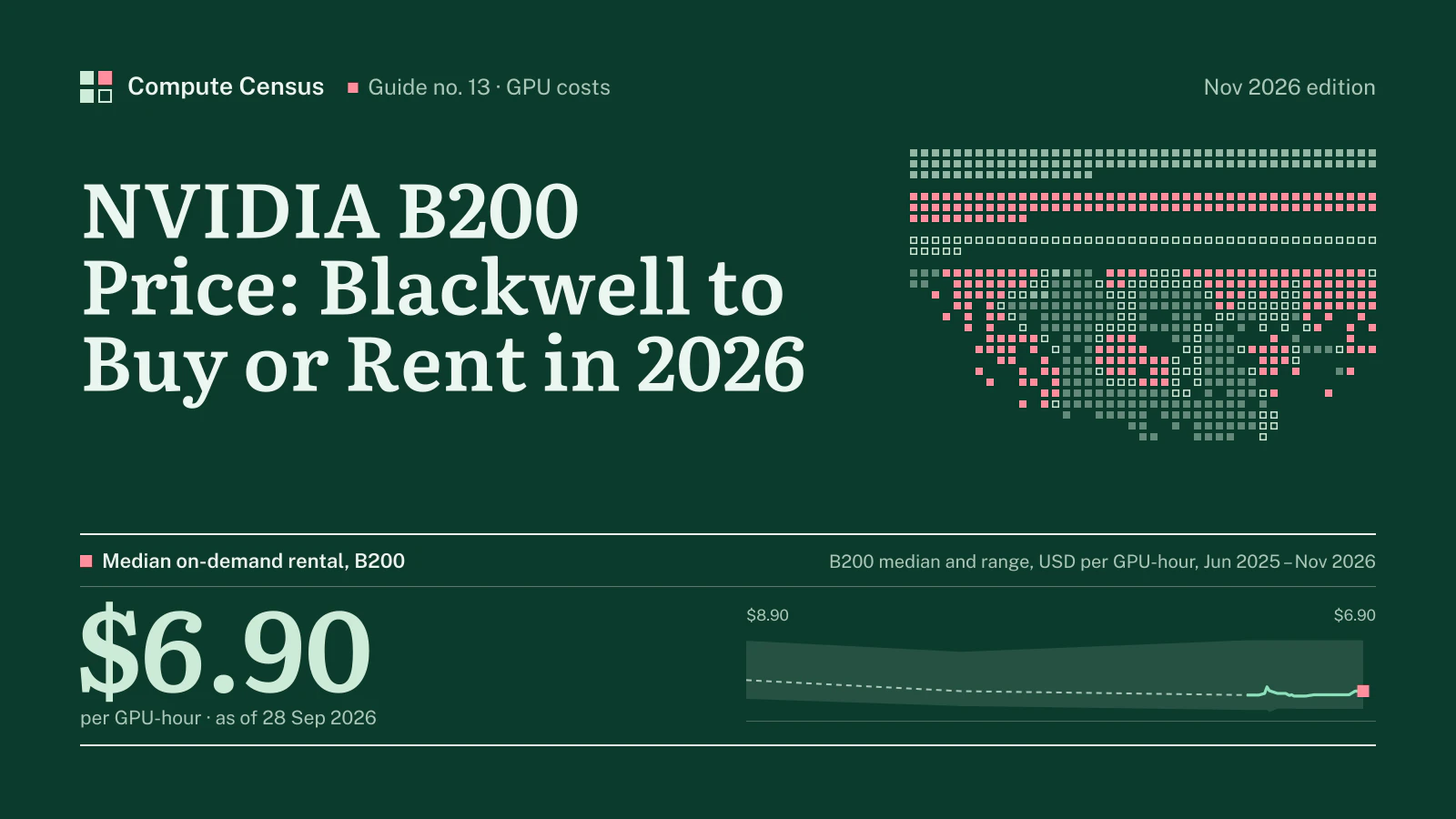
Renting is the other way in, and it is the market we measure. At the Compute Census index of 6 Nov 2026, the median on-demand price of a B200 is $6.90 per GPU-hour, the cheapest accepted offer is $3.69 and the most expensive list price is $16.11. The ceiling sits 4.4× above the floor.
The rest of this guide takes those numbers apart. It covers what the B200 is, what a card, a DGX server and a rack-scale system cost, what the hardware costs to power and house, what the rental market charges and why the spread is wide, and where the break-even between buying and renting falls. Every external figure is dated and listed on our Sources page. Every rental figure comes from our own price index and updates when the index does. For the model page with every provider’s quote, see B200 rental prices.
What the B200 is
One name, three shapes
“B200” is the Blackwell-generation data center GPU that NVIDIA sells in three forms. The first is the bare module on the HGX baseboard, eight to a board, which server makers such as Dell, Supermicro, HPE and Lenovo build into their own chassis. The second is the DGX B200, NVIDIA’s own eight-GPU server, which is the reference design. The third is a part of something larger: the Blackwell GPUs inside a GB200 NVL72 rack are paired with Grace CPUs and have their own part name, but they come from the same silicon family and are often discussed under the same search terms.
NVIDIA’s HGX specification table lists the HGX B200 at 1.4 TB of GPU memory across the eight-GPU baseboard, fifth-generation NVLink at 1.8 TB/s from one GPU to another and 14.4 TB/s in total, and FP4 tensor performance of 144 petaFLOPS sparse or 72 petaFLOPS dense for the board. The footnote on the page says dense performance is half the sparse figure. NVIDIA does not state a per-GPU power rating on that page.
What the DGX B200 contains
The DGX B200 page gives the same board a full system around it. NVIDIA’s numbers are 1,440 GB of GPU memory in total, 64 TB/s of HBM3e bandwidth, 72 petaFLOPS of FP8 and 144 petaFLOPS of FP4, both quoted with sparsity, and 14.4 TB/s of aggregate NVLink bandwidth. The user guide adds two Intel Xeon 8570 processors with 56 cores each, two terabytes of system memory expandable to four, eight ConnectX-7 network cards for the compute fabric and two BlueField-3 cards for storage and management.
Divide the memory by eight and each GPU carries 180 GB, which is the figure our index uses for the model. That is more than twice the 80 GB of the H100 and well above the 141 GB of the H200, and it is the single most useful fact when deciding whether a B200 is worth its price. A model that needs two H100s for its weights alone may fit on one B200, and the per-gigabyte price in our table later in this guide tells a different story from the per-GPU price.
Why the generation matters for price
NVIDIA’s claims for the rack-scale version are larger still. Its GB200 NVL72 page claims 30 times the real-time trillion-parameter inference performance of the H100, 4 times the training performance and 25 times the performance at the same power, with test conditions listed in the footnotes, among them a 50-millisecond token latency target and a cluster of 32,768 GPUs. Those are vendor figures at a specific configuration, and they describe the rack, not a single B200 in an eight-GPU box. We quote them to show what the price is for, not as a promise for any particular workload.
For a buyer, the point is simple. A B200 does more work per GPU and per watt than the Hopper parts that came before it, so its price per hour should be judged against the work it finishes, not against the H100’s hourly price. Our guide to H100 vs H200 walks through the same reasoning one generation earlier.
What one B200 costs to buy
The number nobody publishes
Search for a B200 price and the first results are blogs repeating the March 2024 remark. Huang’s range of $30,000 to $40,000 was given on CNBC’s Squawk on the Street while he held up a chip, in the same breath as the R&D estimate. It was a statement of the order of magnitude, made before the product shipped, and not a quotation.
NVIDIA’s own product pages tell the same story. The DGX B200 page lists no price and sends the reader to its “Get DGX” and “Where to Buy” pages. The AWS page for its B200 instances lists none either. The company sells the part into a channel, and the channel sets the price.
What you can derive from a server price
The most reliable per-GPU figure is arithmetic on a server price. Deploybase’s $275,000 to $300,000 for a DGX B200 implies about $34,400 to $37,500 for each of the eight GPUs, once the chassis, processors, memory, network cards and storage are counted in. That sits inside Huang’s range, which suggests the two numbers describe the same market. It also means the card is not the bargain it looks like: the $30,000 to $40,000 buys the GPU, and the server around it is paid for on top, on a pro-rata basis in the DGX price.
We would not use either number as a budget. Reseller listings run higher, buyers with volume run lower, and the market has moved since the March 2026 date on the tracker’s page. Our own purchase records, collected from sellers’ listing pages and shown as ranges by configuration and date, are on the model page rather than here, because a price without its date and configuration is not a price.
New, used and the missing secondary market
For the H100 there is a deep used market. The B200 does not have one yet: the part is still young, and nobody retires a GPU at that age. SemiAnalysis reported in April 2026 that capacity was sold out and that B200 rental capacity was hard to find for any term by March. When the new part is both scarce and productive, owners keep it running. Anyone quoting a “used B200” price today is quoting a transaction that is rare and a guess that is cheap.
What a complete server costs
The DGX B200
The DGX B200 is the reference system and the easiest one to price because its configuration is fixed. NVIDIA’s user guide gives the physical numbers that matter to a facility. The system draws up to 14.3 kW from six 3.3 kW power supplies in a 5+1 layout, occupies ten rack units and weighs up to 142.4 kg. The system boots only when at least three of the six supplies work. It operates between 10 and 35 degrees Celsius at the inlet.
Deploybase put on-premises DGX B200 systems at $275,000 to $300,000 as of March 2026. Listings from resellers can sit far above that: the British builder Broadberry listed a Blackwell DGX B200 at $515,410.43 in October 2024. The Wccftech article that reported the listing is dated 12 October 2024 and gives no date for the listing itself, and the system was new to the market then. The older listing is not a contradiction of the newer tracker figure. It shows how much the asking price of the same box depends on the seller and on how scarce the part is at the time.
HGX B200 from server makers
Most B200 servers are not DGX. Server makers build their own eight-GPU chassis around the HGX baseboard, with their own choices of processors, memory, network cards and cooling. The configuration differences are large enough to move the total by tens of thousands of dollars: two terabytes of memory or four, 400 Gb/s network cards or slower ones, an air-cooled chassis or a liquid-cooled one. A quote for “an eight-GPU B200 server” is only comparable with another if both list the same parts.
The check is to divide by eight and ask what the other side of the division includes. A price per GPU that includes storage, a three-year support contract and installation is a different thing from one that is a bare chassis with the GPUs fitted.
What is missing from a server quote
A server price buys compute, not a cluster. Training jobs that span more than one server need a fabric between them, and the DGX B200’s eight compute network cards and four OSFP ports exist for that reason. Switches, optics, cabling, storage and a hall to put it all in come on top. SemiAnalysis’s analysis of the GB200 supply chain makes the point for the rack-scale design: it prices NVLink transceivers alone at $550,800 per rack, or $2,203,200 after a 75 percent NVIDIA gross margin markup. That is a figure about the NVL72 and not about an eight-GPU B200 box, but the lesson holds for both: the interconnect is a large part of the cost of a Blackwell system, and it rarely shows in a headline GPU price.
GB200 NVL72: when the rack is the product
One domain of 72 GPUs
The GB200 NVL72 is not a bigger B200 server. It is a liquid-cooled rack that joins 72 Blackwell GPUs and 36 Grace CPUs into a single NVLink domain, with 13.4 TB of HBM3e memory and 576 TB/s of memory bandwidth, according to NVIDIA’s page, and 130 TB/s of NVLink bandwidth between GPUs. For a model that is too large for eight GPUs, the rack removes the slow hop between servers.
We track the GB200 in the index per GPU, which lets a rack-scale slot sit beside an eight-GPU B200 in the same table. The two are different products, and the index treats them as different models.
Power and cooling
SemiAnalysis states that the form factor “requires approximately 120kW per rack”, and puts the draw at 123.6 kW per NVL72 once the losses of converting alternating to direct current are counted. It contrasts that with about 12 kW for a general-purpose CPU rack and about 40 kW for a higher-density air-cooled H100 rack, and says that moving well past 40 kW per rack is the primary reason liquid cooling is required for GB200. It adds that an NVL36x2 layout of about 66 kW per rack is more deployable, since many data centers cannot support 120 kW racks.
That is the practical edge of buying rack-scale hardware. The rack arrives in one piece, needs chilled liquid and power distribution that most halls do not have, and is useless until both are in place. Our guide to AI data center servers explains the facility side in more detail.
What a B200 costs to run
Electricity
A DGX B200 draws up to 14.3 kW, which is about 1.79 kW per GPU at the maximum input rating. Real draw depends on the load, and a training job holds a Blackwell server closer to its limit than a lightly used inference node does. We use the maximum as a conservative planning number, not as a measurement.
The facility adds its own overhead, measured as power usage effectiveness, or PUE: total facility power divided by the power used by IT equipment. The Uptime Institute’s 2026 survey reports an industry-wide annual average PUE of 1.52, falling to 1.36 when the average is weighted by capacity, because large sites run more efficiently. Electricity prices finish the calculation. The US Energy Information Administration reports average retail prices for August 2026 of 14.47 cents per kWh for commercial customers and 9.64 cents for industrial ones. At 1.79 kW per GPU, a PUE of 1.36 and the industrial price, one B200 costs about 23 cents an hour in electricity while it runs. That is real money across a cluster, but it is a small share of the hourly price of the GPU. The larger line is the hardware itself.
Hosting
Few buyers own a hall that can take a 14 kW server, let alone a 120 kW rack. They lease space and power from a colocation provider. CBRE’s North America report for the second half of 2025, published on 25 February 2026, gives an average asking rate of $195.94 per kW per month for 250 to 500 kW requirements in primary markets, up 6.5 percent in a year, with vacancy at a record low of 1.4 percent.
At 1.79 kW per GPU, that is about 48 cents per GPU per hour, paid whether the GPU is busy or idle, and about twice the electricity bill. Contracts differ in what the rate includes, so read the power terms line by line. Colocation pricing is the subject of our sibling publication, Watt and Rack, which tracks provider prices per kW.
People, spares and capital
The remaining costs are harder to put on one line. Blackwell clusters need engineers who can diagnose a failed node at night, spares on site, monitoring, security and insurance. Buyers who borrow pay interest, and buyers who pay cash give up the return they could earn elsewhere. Deploybase also notes site preparation, cooling, network and facility upgrades for a DGX B200 as separate items, each in the thousands to tens of thousands of dollars. None of this appears in a server quote, and all of it appears in the real cost of owning B200s.
What the rental market charges
The index in one table
Renting moves every one of those costs onto the provider. The renter pays one hourly price and leaves when the job is done. The Compute Census index records that price across providers. At the snapshot of 6 Nov 2026, it counts 12 providers with a published B200 price and 14 price points. The median is $6.90, and the 12-month reserved rate, where one is published, is not published.
Table 1B200 prices by provider, USD per GPU-hour
| Provider | Offer | USD / GPU-hr | As of |
|---|---|---|---|
| Verda | Spot | $3.12 | 2026-09-28 |
| DeepInfra | On-demand | $3.69 | 2026-09-28 |
| Packet.ai | On-demand | $3.75 | 2026-09-28 |
| Civo | On-demand | $3.79–$4.49 | 2026-09-28 |
| Nebius | On-demand | $3.95–$7.15 | 2026-09-28 |
| Beam | On-demand | $4.11 | 2026-10-20 |
| CoreWeave | On-demand | $4.26–$8.60 | 2026-09-28 |
| CoreWeave | Spot | $4.26 | 2026-10-20 |
| Silicon Data index | Third-party index | ~$5.45 | 2026-09-28 |
| Verda | On-demand | $6.23 | 2026-09-28 |
| AIMultiple index | Third-party index | ~$6.52 | 2026-09-28 |
| Lambda | On-demand | $6.69–$6.99 | 2026-10-20 |
| Vast.ai | Marketplace | ~$6.82 | 2026-09-28 |
| Runpod | On-demand | $7.99 | 2026-10-20 |
| Oracle Cloud | On-demand | $14.00 | 2026-09-28 |
| Google Cloud | On-demand | $16.11 | 2026-09-28 |
Price points recorded by the Compute Census index for the B200; third-party index rows are context, not providers. Full table: B200 rental price.
The spread has a clear structure. At the bottom sit marketplaces and newer neoclouds, which publish a per-GPU rate for dedicated nodes. In the middle sit the established GPU clouds. At the top sit the hyperscalers, whose list prices bundle a full cloud platform and are rarely what large customers pay after discounts. Our floor and median leave spot and preemptible offers out, so an interruptible rate never pulls the headline down.
How the price has moved
Figure 1B200: median on-demand rental price and published range, USD per GPU-hour, 2025-06-01 to 2026-11-09
The B200 index has a short history, because the part reached public clouds later than the H100 did. Against 1 Dec 2025, the median has moved 0%. The first median we recorded, on 1 Jun 2025, was $8.90. Read the chart before you read the percentage, because a young index is sensitive to which providers enter it and when.
The wider market context is a tight one. SemiAnalysis reported in April 2026 that on-demand capacity was sold out across all GPU types, that capacity coming online through August and September 2026 was already booked, and that Blackwell deployment lead times were stretching into June and July 2026. It quoted anecdotal reports of customers paying $14 per GPU-hour for p6-b200 spot instances on AWS, and noted that its own contract index covers the H100 only; B200 and GB200 data is for institutional subscribers. We cannot cite what is not published, so the B200 contract curve is not in this guide.
Hyperscaler list prices
The cleanest published hyperscaler number is on AWS. Its EC2 Capacity Blocks pricing page lists the eight-GPU p6-b200.48xlarge at $113.666 per instance-hour, or $14.208 per GPU-hour, against $47.757 per instance-hour, or $5.970 per GPU-hour, for the eight-GPU H100 instance. That is about 2.38 times as much per GPU-hour. The page does not state an effective date, and says current prices are scheduled to be updated in January 2027.
The instance itself is a useful reference for what “a B200” means in a cloud. AWS’s page lists eight Blackwell GPUs with 1,432 GB of HBM3e in the specification table, 192 vCPUs of fifth-generation Intel Xeon, 2 TiB of system memory, about 30 TB of local NVMe storage and 3.2 Tbps of EFAv4 network bandwidth, 400 Gbps per GPU. The instance is reservable through Capacity Blocks and is not offered in EC2 UltraServers.
Deploybase’s tracker, as of March 2026, lists independent clouds well below that: RunPod at $5.98 per B200 per hour, Lambda at $6.08 and CoreWeave at $68.80 for the eight-GPU system, which is $8.60 a GPU. Those are the tracker’s figures at its date, not ours, and the index above is the better guide to today. The pattern still holds: the same silicon rents for a multiple of its cheapest price, depending on what surrounds it.
Why the same B200 rents for different prices
Four things separate the cheap offers from the dear ones. The first is the network: a node on a non-blocking InfiniBand or Ethernet fabric is worth more than one on a shared one. The second is the terms: a monthly commitment, an hourly rate with no notice, and a spot rate that can vanish are three different products. The third is the platform: a hyperscaler sells identity management, storage and support with the GPU, and the price includes them. The fourth is location and power: capacity that sits in a facility with spare power is priced differently from capacity that is being rationed.
None of the four shows up in a table of hourly rates, which is why a median is a starting point and a quote for your own job is the end of it.
Rent or buy: where the break-even falls
Hours of rent that equal one purchase
The simplest test divides the purchase price by the hourly rate. Table 2 takes a DGX B200 at $290,000, the middle of Deploybase’s March 2026 range, divided by eight GPUs, which is $36,250 per GPU. It shows how many rented hours that money buys at each point in the index and how many months that is at full and at half use. Watts, PUE and the electricity price come from the sections above.
Table 2Rented B200 time that adds up to one purchase (DGX B200 at $290,000 divided by eight, $36,250 per GPU)
| Rental rate | USD / GPU-hr | Hours to equal purchase | Months at 100% use | Months at 50% use |
|---|---|---|---|---|
| Floor, on-demand | $3.69 | 9,824 | 13.5 | 26.9 |
| Median, on-demand | $6.90 | 5,254 | 7.2 | 14.4 |
| Ceiling, on-demand | $16.11 | 2,250 | 3.1 | 6.2 |
Hours = purchase price ÷ rental rate; months = hours ÷ (730 h × utilisation). Rates from the Compute Census index of 6 Nov 2026. Power alone costs an owner about $0.234 per GPU-hour at 1788 W, PUE 1.36 and $0.096 per kWh, before servers, networking, space and staff.
The table answers a narrow question: how long a renter can run before spending the price of the hardware. It ignores everything an owner spends after the purchase and everything an owner gets back by selling the hardware later. For a fair comparison, both sides have to be counted.
The owner’s cost per used hour
Table 3 builds the owner’s side hour by hour. The purchase is written off over three to six years. Hosting is charged on the full power draw every hour of the month, because a lease does not pause when the GPU is idle. Electricity is charged only while the GPU works. The result is the cost of each hour of useful work, at full, 70 percent and 50 percent utilisation, set against the rental index.
Table 3Owner's cost per used B200 GPU-hour, by depreciation period and utilisation, USD
| Written off over | 100% use | 70% use | 50% use |
|---|---|---|---|
| 3 years | $2.09 | $2.89 | $3.95 |
| 4 years | $1.75 | $2.40 | $3.26 |
| 5 years | $1.54 | $2.10 | $2.85 |
| 6 years | $1.40 | $1.91 | $2.57 |
| Rent instead: index median, on-demand | $6.90 | $6.90 | $6.90 |
Inputs: DGX B200 at $290,000 divided by eight, $36,250 per GPU; 1788 W per GPU including its share of the server; PUE 1.36; electricity $0.0964 per kWh (electricity $0.234 per used hour); hosting $195.94 per kW per month ($0.480 per GPU-hour, paid whether the GPU works or not). Green = below the reserved rate, red = above the on-demand median. Not included: networking, storage, staff, financing, resale value. Rental rates from the Compute Census index of 6 Nov 2026.
Two lessons come out of the table. First, ownership is cheap per hour only when the hardware stays busy. Every idle hour is paid twice by an owner, once in depreciation and once in hosting, while a renter pays nothing for hours not used. Second, the depreciation period does most of the work. An owner who writes the hardware off over three years carries a much higher hourly cost than one who assumes six, and the right assumption depends on how long Blackwell stays useful.
The table leaves things out on purpose. Network switches, storage, staff, spares, insurance and the cost of capital come on top, and a resale value at the end comes off. A buyer should fill each of those lines with real quotes before trusting any break-even, including ours. We have not found a published resale curve for the B200, and we will not guess one.
When buying wins, and when renting does
Buying makes sense when four things are true at once: the workload is steady for years, utilisation stays high, a facility with enough power and cooling is already available, and the team can operate the hardware. Large model developers and providers that resell capacity meet all four, and for them owning is how margin is made.
Renting makes sense when any one of those fails. Research teams with bursty jobs, start-ups whose plans may change in six months, companies testing whether a model is worth deploying, and anyone without a rack that can take 14 kW all pay less by renting, even at a higher hourly price. Reserved contracts sit in between: the buyer commits to a term and gets most of the owner’s price without the owner’s risk. For the general case, see our guide to renting a GPU.
B200 against its neighbours
Price per GPU and price per gigabyte
A B200 is rarely chosen alone. The real comparison is with the H100 and H200 on one side and the rack-scale GB200 on the other. Table 4 sets them side by side from the index, with the memory per GPU and the price per gigabyte of that memory.
Table 4Hopper and Blackwell in the rental index, USD per GPU-hour
| Model | Median | 12-mo reserved | Memory | Median per GB of memory | Median × 730 h | Floor | Ceiling | Providers |
|---|---|---|---|---|---|---|---|---|
| H100 | $3.90 | $3.26 | 80 GB | $0.049 | $2,847 | $1.30 | $12.29 | 11 |
| H200 | $4.80 | $3.40 | 141 GB | $0.034 | $3,504 | $2.09 | $13.78 | 9 |
| B200 | $6.90 | not published | 180 GB | $0.038 | $5,037 | $3.69 | $16.11 | 12 |
| GB200 | $13.25 | $10.58 | 186 GB | $0.071 | $9,673 | $8.00 | $27.04 | 5 |
USD per GPU-hour, on-demand unless stated. Compute Census GPU price index of 6 Nov 2026.
The per-gigabyte column is the one to read first for inference on large models, where memory decides how many GPUs a job needs. It is less useful for training, where compute and the network matter more. A GPU that costs more per hour and less per gigabyte can be the cheaper way to serve a model that does not fit elsewhere.
What the speed claims mean
NVIDIA’s claims for Blackwell, 30 times the inference throughput and 4 times the training throughput of the H100 for the GB200 NVL72 at the test conditions it lists, are rack-scale numbers at a specific latency target and cluster size. A single eight-GPU B200 server will not reproduce them, and no published figure we found converts them into a per-GPU multiplier you can apply to your own model.
The sound way to compare is to run your own job on both parts for an hour and divide the price by the work done. Where that is not possible, the comparison should use published benchmarks of the model you intend to run, at the batch size and context length you intend to use. Our guide to inference cost shows the arithmetic that turns a GPU-hour price and a throughput into a price per million tokens.
When an older GPU is the better buy
Not every job needs Blackwell. If a model fits comfortably in 80 GB, if the job is not bound by memory bandwidth and if the network is not the bottleneck, an H100 may finish the work at a lower total cost, even though the B200 finishes it faster. The fast part is cheaper per unit of work only if its premium over the older part is smaller than its speed advantage. That depends on the job, and Table 4 gives the premium side of the equation.
Supply: why the price holds
Demand that outran capacity
NVIDIA reported data center revenue of $89.0 billion for the quarter that ended on 26 July 2026, up 117 percent from a year earlier, on total revenue of $96.2 billion. Its press release states that Vera Rubin, the next platform after Blackwell, is “ramping into full production with racks running at partners”. The company is selling the current generation as fast as it can build it while preparing the next.
For a buyer of B200s, that has two consequences. The first is that supply is allocated: large customers with long commitments are served first, and a small buyer’s order waits. The second is that the next generation will arrive while Blackwell is still new. Whether it lowers B200 prices depends on how much capacity the new platform adds and how quickly buyers move to it. The H100 shows that older GPUs stay in demand while capacity is short.
What the lead times say
SemiAnalysis reported Blackwell deployment lead times stretching into June and July 2026 at the time of its April article. Lead times of that length push buyers to rent in the interim, which supports rental prices, and push renters to sign longer terms, which removes capacity from the on-demand pool. We have no published figure for current lead times and do not give one.
Export rules
The B200 is an export-controlled product, and the rules have changed more than once since Blackwell launched. We have not re-verified the current licence position for this guide, and a buyer outside the United States should treat it as a question for the seller and for counsel before any deposit is paid. A price that comes without end-user questions is a warning sign, not a bargain.
Where the B200s run: power at campus scale
A Blackwell cluster has to live somewhere with enough power. That is the second series we publish: a census of AI data center campuses, counted from public records. As of 15 Nov 2026, it lists 665 AI campuses in 56 countries. Those under construction add up to 51.1 GW of published capacity, announced projects to another 37.6 GW, and 27 single campuses are rated at a gigawatt or more.
Table 5AI campuses in the census by published capacity class
| Capacity class | Campuses | With published MW | Published MW |
|---|---|---|---|
| 1 GW or more | 27 | 27 | 41,730 |
| 500–999 MW | 18 | 18 | 11,386 |
| 100–499 MW | 156 | 156 | 33,370 |
| Under 100 MW | 295 | 295 | 11,380 |
| Not published | 169 | 0 | 0 |
Compute Census AI campus census, records to 15 Nov 2026. MW summed only where a source publishes a figure. Full list: AI data center census.
Set the rack numbers beside the campus numbers. A DGX B200 is 14.3 kW, and a GB200 NVL72 rack is approximately 120 kW. A hall that holds a thousand NVL72 racks is a 120 MW load before cooling, which is the scale of a mid-sized campus: the median AI campus in our census that publishes a figure is rated at 70 MW. The B200 is a product of the same constraint that defines the census. Hardware arrives faster than connected power, and the price of renting reflects that.
For the pipeline of campuses under construction, and the wider map of the industry, the Mega Watt Atlas tracks projects in more detail than we do.
Five mistakes in reading B200 quotes
Most bad B200 decisions start with a comparison that was never like for like. These are the five we see most often.
Comparing a GPU price with a server price
A card price and a server price differ by the whole rest of the server. Divide any server price by eight to compare it with a per-GPU number, and note what is in the box. A figure from a tracker, a reseller and a spoken estimate in a television interview are three different kinds of number.
Comparing a node price with a GPU price
Cloud providers often price the whole eight-GPU instance, while marketplaces and neoclouds price one GPU. AWS lists its B200 instance at $113.666 per instance-hour, which is $14.208 per GPU-hour once divided by eight. Normalise every quote to one GPU-hour before it goes into a table.
Taking a hyperscaler list price as the market
The ceiling of our index is a list price from a hyperscaler, and it sits 4.4× above the floor. Large customers of those clouds rarely pay list, and smaller buyers rarely need the platform the list price includes. The median is a better guide to what a self-serve buyer pays, and an individual quote for a block is a better guide again.
Reading a spot rate as an on-demand rate
A spot rate is a rate the provider can take back. We leave spot and preemptible offers out of the floor and the median for that reason. A headline of “B200 from” followed by a low number is, more often than not, a spot or a marketplace rate.
Ordering hardware before securing power
The last mistake is the most expensive. A DGX B200 needs a rack that can deliver 14.3 kW today, and a GB200 rack needs liquid cooling and around 120 kW. Vacancy in primary North American colocation markets was 1.4 percent at the end of 2025, according to CBRE. Buyers who order servers first and look for a home second can wait months with idle hardware that loses value every week. Secure the site, or rent until the site is ready.
How to source B200 capacity in 2026
Decide what you are buying
Start with the job, not the GPU. Training a large model across many servers needs HGX or DGX systems on a fast fabric, or a rack-scale system if the model needs a larger NVLink domain. Fine-tuning and inference of smaller models may run well on older GPUs. Compare the B200 against its neighbours in Table 4 before committing, and use our H100 price guide if the older part is a candidate.
Questions for a seller of hardware
- Is it a DGX B200, an HGX B200 server from an OEM, or a rack-scale system?
- What exactly is in the server: processors, memory, network cards, storage, power supplies?
- Is it air-cooled or liquid-cooled, and what are the inlet temperature and power limits?
- What are the lead time, delivery terms, warranty and export paperwork for your country?
- Where will it be hosted, and is the power there contracted today?
Questions for a provider of rented capacity
- Is the price for dedicated nodes, shared pools, spot or serverless capacity?
- What is the minimum term, and what are the exit terms?
- Which fabric links the nodes, and is it non-blocking at your cluster size?
- What happens when a node fails: replacement time, credits, spare capacity?
- Where is the data stored, and what does it cost to move it out?
We handle both routes. GPU capacity is available for rent and hardware for purchase, through different partners, and the terms are agreed individually for each request: there is no fixed commission and no fixed minimum. Tell us the variant, quantity, location and timing in the form below, and we come back with what is available and on what terms.