The short answer
NVIDIA holds the large majority of the data center GPU market, and no one can say by exactly how much. There is no audited market share figure for AI accelerators. Nobody counts every chip sold, and the companies that sell them report revenue in segments that mix GPUs with CPUs, networking and software. What exists instead is a set of estimates, and they agree on the shape more than on the digits.
No one publishes an audited figure. Silicon Analysts, working from public filings and analyst reports, puts NVIDIA at about 87 percent of AI accelerator revenue in 2024, 80 to 81 percent in 2025 and about 75 percent in 2026, with AMD at 7 to 10 percent and Broadcom’s custom chips at 12 to 15 percent in 2026. The spread between estimates comes mostly from whether custom silicon counts. Count only merchant GPUs, the chips anyone can buy, and NVIDIA’s share is higher. Count every accelerator, including the custom designs that Google and others build with Broadcom, and it is lower.
The revenue gap is larger than the share gap suggests. NVIDIA reported data center revenue of $89.0 billion for the quarter that ended on 26 July 2026, up 117 percent from a year earlier. AMD’s whole Data Center segment, GPUs and server CPUs together, earned $8,546 million in the quarter that ended in September. Even after allowing for the different quarter ends and for the CPUs inside the AMD figure, NVIDIA’s data center business is roughly ten times the size of AMD’s segment.
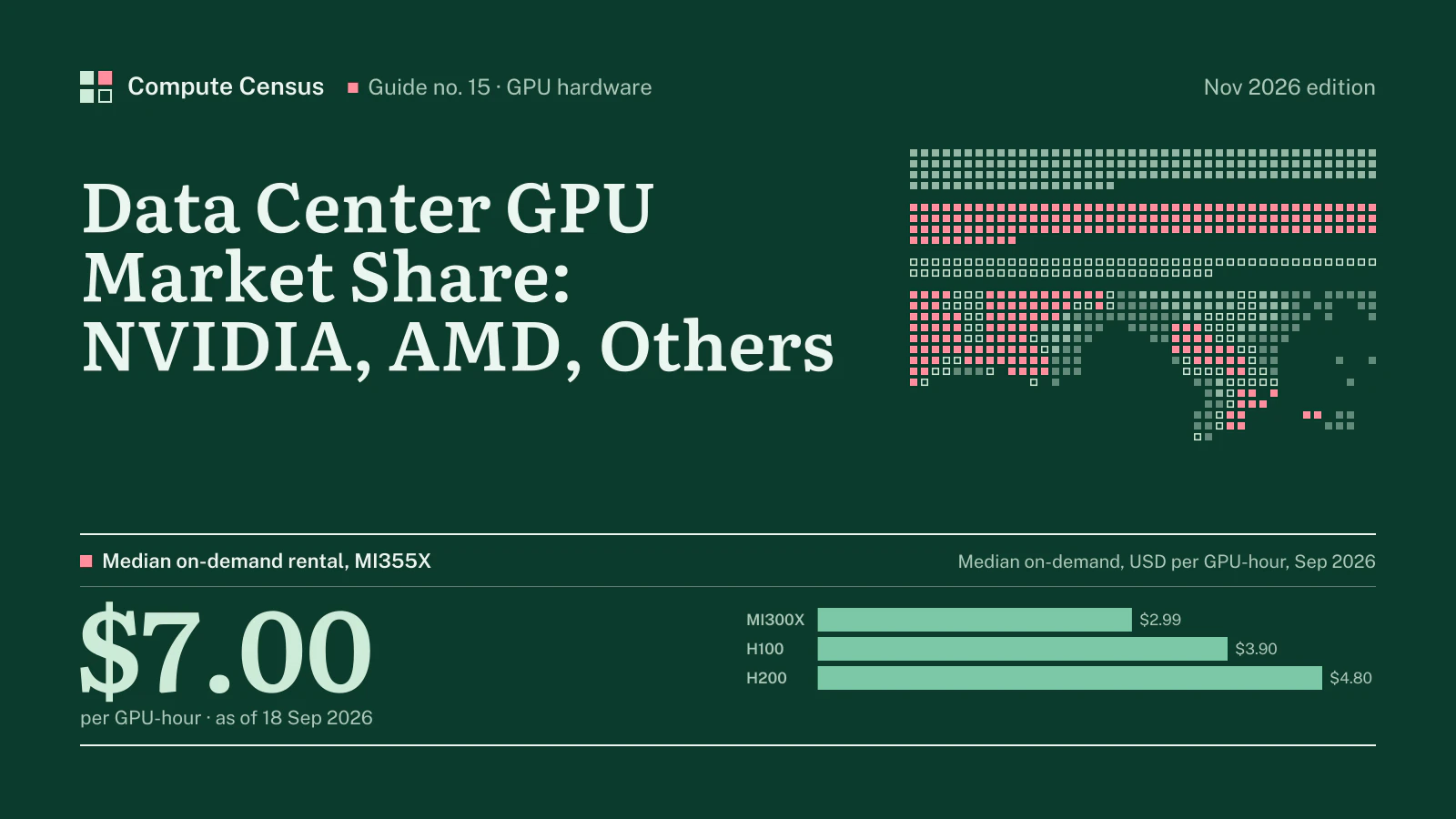
Renting is where the competition becomes visible in prices, and it is the market we measure. In the Compute Census index of 6 Nov 2026, the AMD MI355X has a median on-demand price of $7.00 per GPU-hour from 6 providers, with 288 GB of memory per GPU. The NVIDIA B200, its nearest rival in the same generation, has a median of $6.90 from 12 providers. Those two numbers say something that no share estimate can: AMD’s GPUs are real products with a public price, and they are rented by far fewer providers.
This guide takes the pieces apart. We explain why market share is hard to define, set out what NVIDIA and AMD report, look at the custom accelerators from Google, Amazon and Broadcom’s other customers, deal with Intel and with China, and then put our rental index next to the share estimates. It ends with a short list of mistakes people make when they quote a market share, and with how to source capacity from either vendor. Every external figure is dated and listed on our Sources page, and every rental figure comes from our index and updates when the index does.
Why there is no single market share number
Four ways to count
“Market share” in this industry can mean four different things, and the headline figures mix them freely.
- Share of revenue. The vendor’s sales of accelerators in dollars. This is what the estimates above use. It favours the vendor with the highest prices, which is NVIDIA, and it counts a rack-scale system at the value of the whole system or only of the chips, depending on who is counting.
- Share of units. The number of accelerators shipped. Cheaper chips count the same as expensive ones, so a vendor selling many low-cost parts looks bigger than its revenue says. Custom chips from hyperscalers show up strongly here, because they cost less per unit than a merchant GPU.
- Share of installed base. Everything in service, including hardware bought years ago. NVIDIA’s share is higher on this count than on any current-year count, because the installed base carries the years in which it faced almost no competition.
- Share of power. The gigawatts of data center capacity that a vendor’s hardware will draw. The big deployments announced in 2025 and 2026 are quoted this way, in gigawatts rather than in chips or dollars, and we return to them below.
None of these is wrong. They answer different questions. A bank asking where the money goes wants revenue. A data center operator asking what to build wants power. A buyer asking what is available to rent wants the installed base and the count of providers who list a price.
What gets counted as a GPU
The second problem is the definition of the product. A custom accelerator such as Google’s TPU is not a GPU, yet it does the same job and competes for the same budget. Counting it lowers NVIDIA’s share, leaving it out raises it. The estimates quoted above differ for exactly this reason: the range for NVIDIA’s 2026 share runs from about 70 percent to 86 percent in the roundups we read, and the low end includes custom silicon.
A third distinction is between chips and systems. NVIDIA increasingly sells whole racks and networking with its GPUs, and AMD’s MI450 generation is launching in a rack-scale design of its own. A revenue figure for “data center” from NVIDIA includes networking. The company’s filing does not split compute from networking in the quarterly release, so any share estimate built from it has to make an assumption.
Discrete GPU share is not data center share
One figure circulates more than any other and is the wrong one. Jon Peddie Research reported that NVIDIA held 90 percent of the discrete GPU market in the second quarter of 2026, against 8 percent for AMD, according to The Motley Fool’s September 2026 article. That number measures graphics cards, the add-in boards sold for gaming and workstations, by unit shipments. It says almost nothing about data center accelerators, where AMD’s share and the role of custom chips differ. When a headline says NVIDIA has “90 percent of the GPU market”, ask which market. The data center figure is lower on every estimate we found.
What NVIDIA reports
The quarter in numbers
NVIDIA’s second-quarter fiscal 2027 results, for the quarter that ended on 26 July 2026, show total revenue of $96,221 million, up 18 percent from the previous quarter and 106 percent from a year earlier. Data Center revenue was $89.0 billion, up 18 percent in the quarter and 117 percent in the year. The release says Vera Rubin, the platform that follows Blackwell, is in full production, with racks running at partners that include CoreWeave, Google Cloud, Microsoft Azure, Oracle Cloud Infrastructure and Nebius.
Gross margin on a GAAP basis was 75.0 percent. That figure matters for the market share debate more than it seems to. A vendor that keeps three quarters of every sales dollar after the cost of goods has a lot of room to cut prices if a rival gets close, and NVIDIA’s customers know it. Competitors have to be priced against a seller that can afford to respond.
For the third quarter, NVIDIA guided to revenue of $108.0 billion, plus or minus 2 percent. The guidance carries a sentence we return to in the China section: it assumes no Data Center compute revenue from China.
Who buys
The annual report for fiscal 2026, the year ended 25 January 2026, gives the concentration of the customer base. One direct customer accounted for 22 percent of total revenue and another for 14 percent, both mainly in the Compute and Networking segment. Customers headquartered outside the United States made up 31 percent of the year’s revenue.
Concentration of this kind explains why custom silicon matters to a share estimate even when it is small today. Two direct customers, which are presumably system makers and cloud providers that resell to others, accounted for more than a third of NVIDIA’s revenue. If a few large buyers shift part of their spending to their own chips, NVIDIA’s share moves by points, and the numbers do not need to change much for that to happen. The filing also names the competitors NVIDIA sees: AMD, Huawei and Intel among suppliers of GPUs and accelerated computing products, and Alibaba, Alphabet, Amazon, Baidu, Huawei and Microsoft among the large cloud companies that design their own hardware.
What the filings do not say
Neither the release nor the annual report states a market share, and NVIDIA does not publish unit shipments of its GPUs. The 22 and 14 percent figures describe customers, not products. A reader who wants NVIDIA’s share must take an outside estimate of the total market and divide, and the total is the weakest number in the calculation. That is the reason the figures in the short answer carry the label “estimate”, and the reason we do not state a single share in this guide as fact.
What AMD reports
A segment that hides the GPU
AMD’s third-quarter 2026 results, released on 3 November 2026, put Data Center segment revenue at $8,546 million, up 97 percent from $4,341 million a year earlier and up from $6,718 million in the second quarter. For the first nine months the segment earned $21,039 million against $11,255 million in the same period of 2025. Total company revenue was $13.4 billion.
AMD does not report Instinct revenue separately. Its Data Center segment, which holds EPYC server CPUs as well as Instinct GPUs, earned $8,546 million in the third quarter of 2026, up 97 percent from a year earlier. Silicon Analysts estimates Instinct revenue for 2025 at $6 billion to $8 billion. That range is the outside analyst’s estimate, and the article is not consistent with itself: its summary gives a range of $7 billion to $8 billion and its body gives $6 billion to $8 billion. We use the wider one and treat it as an estimate, not a reported figure.
The practical point is that the AMD data center number cannot be read as GPU revenue. A share of the segment is EPYC processors, which sell into every kind of server and not only AI machines. Any claim that AMD earned a given number “from AI GPUs” in 2026 is an estimate, unless AMD itself has said so.
The MI450 and the rack
The company’s release attributes the growth to the launch of the Instinct MI450 Series GPUs. They power the first AMD Helios rack-scale systems, and the release lists Anthropic, Meta, Microsoft, OpenAI and Oracle Cloud Infrastructure as running models and workloads on them. AMD guided to fourth-quarter revenue of about $17 billion, plus or minus 3 percent, and its chief executive said that growth should accelerate further in the fourth quarter as the company scales Helios and its next server processor.
For market share, the rack matters because it changes what AMD sells. A GPU sold alone competes on the chip. A rack sold with networking and software competes on the system, which is how NVIDIA has sold its largest products for two generations. It also means that future AMD data center revenue will carry more than GPU content, and share estimates that treat all of it as accelerator revenue will overstate the chip share.
Renting AMD today
Yes. AMD’s Instinct MI300X and MI355X appear in rental price lists from GPU clouds alongside NVIDIA parts, though from fewer providers. AMD says Anthropic, Meta, Microsoft, OpenAI and Oracle Cloud Infrastructure are running models and workloads on its first MI450 Helios rack-scale systems. The MI450 itself is too new for our index, which records the parts that providers list with a public price.
The OpenAI agreement, in gigawatts
The clearest sign of AMD’s position is a power figure rather than a revenue figure. On 6 October 2025 AMD and OpenAI announced a multi-year, multi-generation agreement to deploy 6 gigawatts of AMD GPUs, with the first 1 gigawatt using MI450 Series GPUs, set to begin in the second half of 2026. AMD issued OpenAI a warrant for up to 160 million shares of AMD common stock, vesting in tranches. The first tranche vests with the initial 1 gigawatt deployment, and later ones as purchases scale toward 6 gigawatts, subject to share-price targets and to technical and commercial milestones on OpenAI’s side.
Two points follow. First, a commitment of 6 gigawatts can be set against the whole census of AI campuses that we track, which we count below. Second, it is a commitment and not a delivery. The warrant structure ties part of AMD’s reward to deployments actually happening, and until they do, the agreement is a statement of intent rather than a share of the market. We have no published figure for how much of the 6 gigawatts has been delivered.
Custom accelerators: the share nobody sells in a shop
Broadcom and the XPU
Custom accelerators are chips designed for one customer, usually a cloud company, and made by a chip company such as Broadcom on that customer’s behalf. They do not appear in a price list. They are rented as cloud capacity, and the best public measure of their volume is what the design partner reports.
Broadcom reported AI semiconductor revenue of $16.7 billion for its third fiscal quarter of 2026, up 221 percent from a year earlier, and guided to $21.7 billion for the fourth. The quarter was also up 54 percent on the one before, and the guidance is 236 percent above the year-earlier quarter. Part of that revenue is networking and part is custom accelerators. We have not found a published split in the sources we opened, so we do not state one. Silicon Analysts, which estimates Broadcom’s custom ASIC share at 12 to 15 percent of AI accelerator revenue in 2026, shows the same direction: the share of custom chips rose from low single digits in 2022 to double digits.
Custom accelerators are growing quickly, but they are sold as cloud capacity or as custom designs for single customers, not as catalogue chips. That sentence is the whole reason they distort every share chart. They are real demand that NVIDIA does not win, yet an enterprise buyer cannot go out and buy one.
Google’s TPU
Google’s seventh-generation TPU, Ironwood, became generally available to cloud customers at Google Cloud Next in April 2026. The Next Web reports 4.6 petaFLOPS of peak FP8 compute per chip, 192 GB of HBM3e memory with 7.37 TB/s of bandwidth, and a 9,216-chip superpod. Against NVIDIA’s B200, the report says compute and memory are similar, with NVIDIA ahead on interconnect bandwidth and FP4 support. Google previewed an eighth generation that splits into a training chip and an inference chip, both on a 2 nm process and aimed at late 2027.
The customer that makes the TPU a market share story is Anthropic. In October 2025 Anthropic said it would use up to one million Google TPUs, coming online in 2026, a deal that delivers more than a gigawatt of capacity and is worth tens of billions of dollars. In April 2026 it signed for multiple gigawatts of next-generation TPU capacity from 2027, reported at 3.5 gigawatts, with the vast majority sited in the United States. Anthropic also uses Amazon Trainium and NVIDIA GPUs, so the TPU commitment is a split of a buyer’s spending, not a replacement of one vendor by another.
The Next Web also reports projected TPU shipments of 4.3 million in 2026, 10 million in 2027 and more than 35 million in 2028. These are projections attributed to the report and not company figures, and we treat them as such. If they are even close, then a growing part of the accelerators installed in large AI campuses will not be GPUs by 2028, whatever NVIDIA’s share of merchant GPUs does.
Amazon, Microsoft and the rest
Amazon’s route is Trainium. Anthropic’s October 2025 announcement kept Amazon as its primary training partner through Project Rainier, a supercomputer using hundreds of thousands of Trainium2 chips. We found no published Trainium revenue or run-rate figure in the sources we opened, and Amazon does not report one in the filings we have seen cited, so the volume of Trainium is a gap in every estimate. The same holds for Microsoft’s Maia and Meta’s MTIA, which Silicon Analysts puts at 2 to 4 percent and 1 to 2 percent of 2025 accelerator revenue respectively, with wide uncertainty.
The pattern across all of them is the same. Each is designed for one operator’s workloads, built through a design partner, deployed inside that operator’s own data centers and not offered to the open market. They therefore matter most for share of units and share of power inside the largest campuses, and least for the buyer of a few hundred GPUs.
Intel
Intel is the vendor with the least to show. Tom’s Hardware’s March 2026 review of its roadmap says Gaudi 3 is shipping and has been available through cloud partners since late 2024, but has not gained a meaningful share in large training clusters. Intel cancelled the commercial release of Falcon Shores and moved its GPU plans toward inference. Its Crescent Island inference GPU, announced in October 2025, uses 160 GB of LPDDR5X memory and was expected to begin customer sampling in the second half of 2026, with no performance figures disclosed. The successor, Jaguar Shores, carries a reported 2027 timeline. For a share estimate in 2026, Intel is a rounding error.
China: the part of the market NVIDIA cannot count
NVIDIA’s annual report for fiscal 2026 says the company was effectively foreclosed from China’s data center compute market by the end of that year, and its third-quarter outlook assumes no Data Center compute revenue from China. The filing records about $60 million of H20 revenue under licences granted in August 2025, and a $4.5 billion charge in the first quarter of fiscal 2026 for excess H20 inventory and purchase obligations. In the filing’s own words, its offerings in China are limited by export controls.
This changes what a global share number means. A global share figure therefore describes a market from which China has largely dropped out of NVIDIA’s numbers. The estimated NVIDIA share of about 75 to 81 percent is a share of a market in which China is a large buyer of accelerators that NVIDIA mostly cannot supply. The Chinese market is supplied by domestic vendors, of which Huawei is the best known, and NVIDIA’s own filing lists Huawei as a competitor. We read reports putting Huawei’s share of Chinese shipments anywhere from under 30 percent to above 50 percent, and the figures conflict, the best-attributed ones are secondary, and we found none that we could trace to the research firm named. We therefore publish no figure for China, and we ask readers to be careful with any that is quoted without a method.
The practical consequence for a buyer outside China is small: the GPUs available to rent or buy in the United States, Europe and the rest of Asia are still overwhelmingly NVIDIA’s, with AMD as the main alternative. For anyone reading a share chart, the consequence is large: the denominator depends on whether China is in it.
What rental prices say about market position
Same generation, different price points
Share estimates measure what vendors sold. Rental prices measure what the market will pay today for the use of the hardware, and they let us compare vendors on the same axis. The index records the median on-demand price per GPU-hour for each model across the providers that list one. Table 1 sets AMD’s MI300X next to the NVIDIA parts it was sold against, and adds memory, so that price per gigabyte can be read alongside price per GPU.
Table 1AMD MI300X against NVIDIA Hopper in the rental index, USD per GPU-hour
| Model | Median | 12-mo reserved | Memory | Median per GB of memory | Floor | Ceiling | Providers |
|---|---|---|---|---|---|---|---|
| MI300X | $2.99 | $1.91 | 192 GB | $0.016 | $1.71 | $12.00 | 7 |
| H100 | $3.90 | $3.26 | 80 GB | $0.049 | $1.30 | $12.29 | 11 |
| H200 | $4.80 | $3.40 | 141 GB | $0.034 | $2.09 | $13.78 | 9 |
USD per GPU-hour, on-demand unless stated. Compute Census GPU price index of 6 Nov 2026.
The MI300X carries 192 GB of memory per GPU, against 80 GB on the H100 and 141 GB on the H200. Its median is $2.99, and it is listed by 7 providers against 11 for the H100. We read the provider count as a market signal: a GPU that few providers rent is harder to find, whatever its price, and a price from three providers is a weaker number than a price from twelve.
Memory is where AMD has chosen to compete. The per-gigabyte column in Table 1 is the clearest view of that choice, and the choice can be seen in the table without any share estimate at all. A workload that is limited by memory capacity, such as serving a large model on as few GPUs as possible, is where an AMD part can make sense. A workload tuned for NVIDIA’s software and interconnect may not move easily, and the price difference has to pay for the work of moving it.
The newest generation
Table 2 repeats the comparison one generation later. The MI355X is AMD’s counterpart to the Blackwell parts. The GB200 is NVIDIA’s rack-scale product priced per GPU, which is a different thing to rent than a single card, as we explain in our guide to the B200.
Table 2AMD MI355X against NVIDIA Blackwell in the rental index, USD per GPU-hour
| Model | Median | 12-mo reserved | Memory | Median per GB of memory | Floor | Ceiling | Providers |
|---|---|---|---|---|---|---|---|
| MI355X | $7.00 | $4.25 | 288 GB | $0.024 | $5.99 | $8.60 | 6 |
| B200 | $6.90 | not published | 180 GB | $0.038 | $3.69 | $16.11 | 12 |
| GB200 | $13.25 | $10.58 | 186 GB | $0.071 | $8.00 | $27.04 | 5 |
USD per GPU-hour, on-demand unless stated. Compute Census GPU price index of 6 Nov 2026.
Read the table for the provider counts first and the prices second. At the snapshot of 6 Nov 2026, the MI355X has 8 price points against 14 for the B200. Its published 12-month reserved rate is $4.25. A market in which the newer AMD part is listed by a handful of providers, and the NVIDIA part by many, is a market where NVIDIA’s installed base and distribution still decide what a buyer can get this month.
We do not draw a conclusion about which vendor is cheaper from a table like this. Prices differ by provider type, by commitment length and by what is bundled, and the medians rest on a small number of quotes for the newer parts. The right use of the index is to see where a price sits in its range, and the spread between the floor and the ceiling is wide in every row.
What a price tells you about share
Rental prices can support one inference about market position, and only one. When a vendor’s GPU has a lot of memory and a published price below a rival’s per gigabyte, but few providers list it, supply is the constraint and not price. That describes AMD’s position in our index. It is a statement about availability, and it does not measure how many AMD chips have been sold.
A second inference we avoid. It is tempting to read a falling AMD price as a sign of share loss or a rising one as a sign of gain. Prices move with provider supply, contract renewals and power availability. Our index recorded the H100 median at $3.90 in this snapshot, a movement of +100% against 1 Oct 2025, and the sources we opened tie recent price changes to shortages of capacity, not to the competitive position of any one vendor. Our guide to GPU prices going up covers that history.
Power: the share that data center operators count
Gigawatts instead of chips
The largest AI deployments are announced in gigawatts, and that is how the competition looks from the site operator’s side. OpenAI’s agreement with AMD is for 6 gigawatts. Anthropic’s TPU deals are for more than a gigawatt in 2026 and multiple gigawatts from 2027. A gigawatt is a measure of the electricity a deployment will draw at full load, and it says nothing about how many chips fit inside it, because chips differ in watts and in work done per watt.
Our census counts campuses in megawatts from public records. As of 15 Nov 2026, it lists 665 AI campuses in 56 countries, with 97.9 GW of published capacity in all. Of that, 9.1 GW is operational, 51.1 GW is under construction and 37.6 GW is announced. 27 single campuses are rated at a gigawatt or more.
Table 3AI campuses in the census by status
| Status | Campuses | With published MW | Published MW |
|---|---|---|---|
| Under construction | 259 | 227 | 51,090 |
| Announced | 131 | 111 | 37,645 |
| Operational | 275 | 158 | 9,132 |
Compute Census AI campus census, records to 15 Nov 2026. MW summed only where a source publishes a figure. Full list: AI data center census.
Compare those totals with a single agreement. A 6 gigawatt commitment from one buyer to one chip vendor can be read against the operational and construction rows of Table 3, and its 1 gigawatt first phase is the size of the campuses we count in the gigawatt class. The census does not record which vendor’s chips run in which campus, because operators rarely publish that, so we cannot turn it into a share of power by vendor. What it does show is the scale of the build that all the share estimates rest on: the numbers vendors report in dollars are paid for by facilities measured in gigawatts, and facilities are the slowest part of the chain.
Why power makes share sticky
A data center is designed around its rack. A rack of NVIDIA’s rack-scale systems draws far more power than a traditional rack, as we describe in our guide on AI data center power consumption, and its cooling, power distribution and network are designed for that machine. Switching a campus from one vendor’s racks to another’s is a rebuild of the hall and not a swap of the hardware. That is one reason an operator that has built for one vendor tends to stay with it, and one reason the first gigawatt of a new vendor is more consequential than the second.
For a buyer, the same logic runs the other way. A buyer who rents capacity does not carry that lock-in, and can test an AMD or a custom-silicon offer for a few weeks without touching a facility. Renting is the cheapest way to learn whether a workload moves across vendors, which is a good reason to price both sides before committing to hardware.
Five mistakes when quoting a market share
Most bad market share claims come from one of five errors. We have seen each of them in the requests and the articles that reach us.
Using a discrete GPU figure for data center
The 90 percent figure for NVIDIA in discrete GPUs measures gaming and workstation cards. It does not describe the accelerator market. If a source does not say “data center” or “AI accelerator” next to the number, assume it does not apply.
Mixing revenue, units and power
A share by revenue, a share by units and a share in gigawatts will all differ for the same market, and mixing them in one sentence gives nonsense. State the unit with every figure, and compare like with like.
Treating AMD’s segment as GPU revenue
AMD’s Data Center segment includes server CPUs. Dividing it by NVIDIA’s data center revenue gives a ratio of two different things. The ratio is still useful as a rough order of magnitude, and we use it that way in this guide, but it is not a GPU share.
Leaving custom silicon out, or counting it twice
A TPU is an accelerator that competes with a GPU for the same budget, and leaving it out of the total raises NVIDIA’s share. A Broadcom revenue line contains both custom accelerators and networking, and counting its entire AI revenue as accelerators overstates the share. Say which treatment the number uses.
Forgetting the date and the denominator
The 87 percent figure for 2024 and the 75 percent estimate for 2026 describe different years and different totals. A share that fell from one to the other has been measured in a market that grew far faster than any one vendor’s sales, so a falling share can come with rising revenue. NVIDIA’s own quarterly revenue more than doubled in a year while its estimated share declined. Always ask what the whole market was when the share was taken.
What the numbers mean for a buyer
Share does not set your price
A buyer of 64 GPUs does not negotiate against the market. The price depends on the provider, the term, the location and the availability of capacity in the week the buyer asks. Market share matters to that buyer in three indirect ways: it decides which software is mature, which providers have stock and how much a second source is worth.
On software, NVIDIA’s installed base means that most open-source tools are tested on its GPUs first. AMD’s rack-scale launch with named customers, including several of the largest AI buyers, is the best sign that the software gap is narrowing, but a gap is a risk to a small team in a way it is not to a large one that can fund its own engineers.
On stock, the provider counts in our index are the best guide. Where only a few providers list a GPU, a buyer has fewer offers to compare and less room to walk away. On a second source, a buyer who can run on both vendors has a stronger position at renewal than one who cannot, and the first step is to test, which is cheaper to do on rented capacity than on owned hardware.
What would change the picture
Four things would move the estimates. The first is delivery of the AMD and OpenAI gigawatts, which would show in AMD’s segment revenue and in the census as campuses with AMD racks. The second is custom silicon scaling as projected, which would lower NVIDIA’s share of units without necessarily lowering its revenue. The third is a change in export rules that reopened or closed China to NVIDIA, which would change the denominator. The fourth is NVIDIA’s Vera Rubin ramp, which the company says is in full production, and which resets the price and performance reference for everything else. We watch each through filings and through our own index, and we date every claim.
How to source GPU capacity from either vendor
Decide what you are buying
Start with the workload and not the vendor. A job limited by memory capacity may fit an AMD part with more memory per GPU. A job already tuned for NVIDIA software, or one that depends on a particular interconnect, usually belongs on NVIDIA hardware. A job with no strong dependency can be priced on both, and the cheaper offer, once availability and support are counted, wins.
Questions for a provider of rented capacity
- Which GPU exactly, and how many are available this month rather than next quarter?
- Is the price for dedicated nodes, pooled capacity, spot or serverless use?
- What are the minimum term and the exit terms?
- For AMD capacity, which software stack is supported, and who supports it?
- What happens when a node fails: replacement time, credits and spare capacity?
Questions for a seller of hardware
- Which model and which form factor, a single server or a rack-scale system?
- What are the lead time and the delivery terms for your country, and what export paperwork applies?
- Where will the hardware be hosted, and is the power contracted today?
- What support and software come with it, and for how long?
We handle both routes. GPU capacity is available for rent and hardware for purchase, through different partners, and the terms are agreed individually for each request: there is no fixed commission and no fixed minimum. Tell us the model, quantity, location and timing in the form below, and we come back with what is available and on what terms.